Oil Painting
Mastering the Canvas: Hard-Won Artistic Secrets with Master Yim
How a life in the theater shaped a painter's eye — and the craft behind the canvas
September 30, 2026
Can a background in theatrical stage design, lighting, makeup, and costume shape the way an artist approaches figurative painting?
In this September 30, 2026 live webinar, Master Yim Mau-Kun reflects on how his early work in the theater influenced his understanding of character, atmosphere, and storytelling in painting.
He also shares practical insights on building strong artistic fundamentals, researching and developing historical narrative works, handling oil paint with greater control, and making more effective decisions about composition, value, and paint application.
What emerges is not just a collection of techniques, but a broader way of thinking about painting: how to observe more deeply, simplify with purpose, and use technical skill in the service of expression.
Learning Objectives
- Analyze the synergistic relationship between theatrical stage design and psychological characterization in oil portraits.
- Design a systematic approach to historical research and fieldwork for authentic narrative art.
- Master the physical mechanics of oil-paint application — specifically thickness control and preventing muddy layers.
- Apply practical compositional and value rules to avoid common pitfalls in portraits, landscapes, and quick sketches.
From the Stage to the Studio: The Dramatic Connection
Master Yim's early career in mainland China was spent in a Guangdong drama troupe. As the sole art technician, he was responsible for everything: lighting design, set arrangement, costume coordination, and even painting battle makeup on the actors.
While stage design and easel painting are technically distinct, they share a profound emotional connection. Stage design serves the dramatic development of a script, using atmosphere, lighting, and spatial arrangement to tell a story. When you translate this to the canvas, it becomes psychological characterization.
An actor's stage presence relies on clear, heightened expressions of inner emotion. In the same way, a great figurative painter does not merely copy a face — they capture the subject's inner character, mood, and dramatic identity. The theatrical eye teaches you to see a painting not as a static object, but as a live stage frozen at its peak narrative moment.
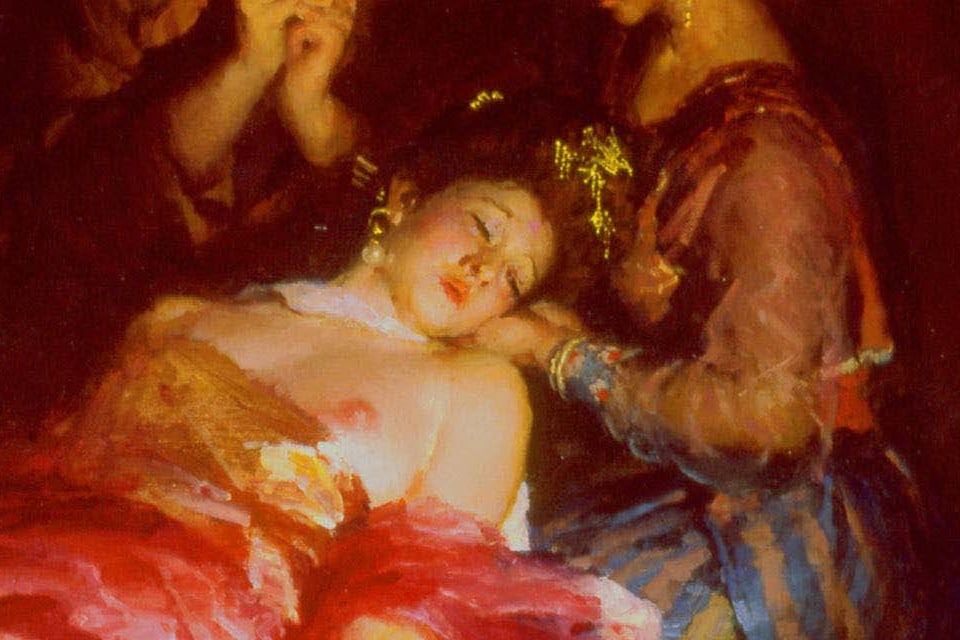
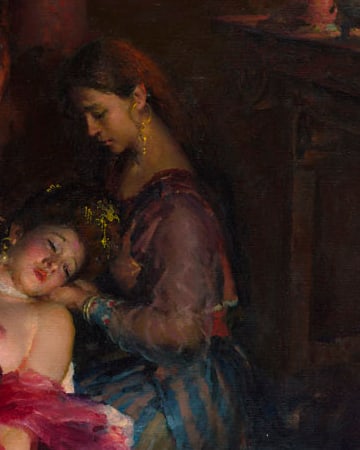
You can see this directly in Yim's own narrative work. In Death of a Concubine (貴妃之薨, 1999), a single lamplit room holds several figures around the dying imperial consort, Yang Guifei — and no two of them feel the same emotion. It is not a group of faces, but a web of relationships caught at one unbearable instant.
Fieldwork and Research: Painting with Authenticity
When painting massive historical or narrative scenes — such as epic migrations across the sea — how do you keep your work from looking cartoonish, overly subjective, or “off-pitch” (荒腔走板)?
The secret is rigorous fieldwork and historical research. Master Yim outlines a dual-track method:
- Textual research: deeply studying historical documents, literature, and records to understand the socio-political and structural context of the era.
- Physical fieldwork: travelling to the exact places where the historical figures lived, struggled, or migrated — coastal Fujian, say, or the historic sites of Xi'an.
By walking the terrain, observing the local light, and experiencing the environment firsthand, you absorb the subtle realities of life. This ensures that the clothing, gestures, anatomy, and lighting of your figures resonate with genuine historical truth, delivering a powerful sense of reality to your audience.
Technical Secrets: Controlling Oil Paint and Value
Why do some oil paintings look rich, deep, and cohesive, while others suffer from muddy layers and distracting glare? It comes down to understanding the physical nature of your medium.
The Golden Rule: Dark Is Thin, Light Is Thick
- Dark colors — thin layers. Keep shadows and dark areas thin and flat. If you stack dark paint — deep blacks, browns, dark blues — into thick, textured ridges, light striking the canvas reflects off those ridges. The result is white specular highlights (glare spots) that instantly destroy your deep values, flattening rich shadow into a distracting gray.
- Light colors — thick layers, impasto. Pale areas, highlights, and bright skin tones can be built up thickly. Because these passages are meant to catch light, the physical texture of the paint works with the illumination to create a rich, three-dimensional surface.
Preventing Wet Paint from Pulling Up
When you paint quickly — in small studies or rapid portraits — wet layers mix easily on the canvas and turn your colors to mud. To prevent this:
- Minimize brushing. Position each stroke carefully and then leave it alone. Do not brush back and forth repeatedly over a wet area.
- Limit solvents and oils. Do not dilute paint into a watery, soup-like consistency. Keep it thick and tacky enough to sit stably on the canvas without running or blending too readily.
Composition and Color Traps: Master Critiques
Drawing on Master Yim's live student critiques, here are the most common traps painters fall into — and how to fix them.
1. The One-Hour Portrait Rule
If you have only one hour with a model, paint only the head. Do not attempt the hands or a complex background. As the old saying goes: “Of humans, the hands are hardest; of beasts, the dog is hardest.” Keep the painted head slightly smaller than life-size to manage your time and keep control of the anatomy.
2. The Dead-Center Trap
In landscape composition, never place your primary focal point — a central pavilion, a lone tree — directly in the middle of the canvas. It creates a static, airless composition that physically blocks the viewer's eye from travelling into the distance. Always look for paths, water, or negative space that lead the eye into the background.
3. Avoid “Half-and-Half” Cropping
When framing a landscape, avoid cutting major structural elements exactly in half — a branch or a wall sliced right down the middle. It makes a painting feel accidental rather than deliberately composed. Walk around your subject and find a dynamic, intentional angle before your brush ever touches the canvas.
4. Overmixing and Muddy Hues
With delicate subjects like roses or skin, avoid overworking the paint on your palette. Stirring colors too much destroys their natural vibrancy and value structure, leaving a dull, muddy gray. The point is not to mix less, but to stop the moment the color is right.
The Art of Creative Discipline
Every artist wrestles with a paradox: the obsessive pursuit of perfection often leads straight to procrastination and missed deadlines. How do you balance the drive for excellence against the cold reality of a schedule?
Master Yim offers a humorous but deeply practical answer: externalize your management. Whether it is a strict partner, an agent, or a rigorous self-imposed calendar, artists need an external structure to keep them grounded.
Understand, too, that a painting is never truly finished; it is only completed to the best of your current ability. Strict deadlines keep you from overworking a canvas and ruining its fresh, spontaneous energy.
And as you progress, remember that plaster-cast drawing (石膏像) remains the bedrock of draftsmanship. If you can draw a plaster cast with accurate values, soft and sharp edges, and structural integrity, your foundation will stay unshakable throughout your artistic career.
Key Takeaways
- Theatrical synergy. Stage design teaches painters how to build narrative environments and capture high-intensity, psychological expressions of character.
- Authentic research. Successful narrative painting needs both rigorous study of historical documents and immersive, in-person geographical fieldwork.
- Thickness physics. Keep dark shadows thin to prevent distracting reflections; paint bright values with a thick, robust impasto.
- Stroke economy. Prevent muddy, lifting layers by applying paint in deliberate single strokes and avoiding over-diluted, watery mixtures.
- Dynamic composition. Avoid the dead center, steer clear of awkward cropping, and always move around to find a dynamic angle before painting.