
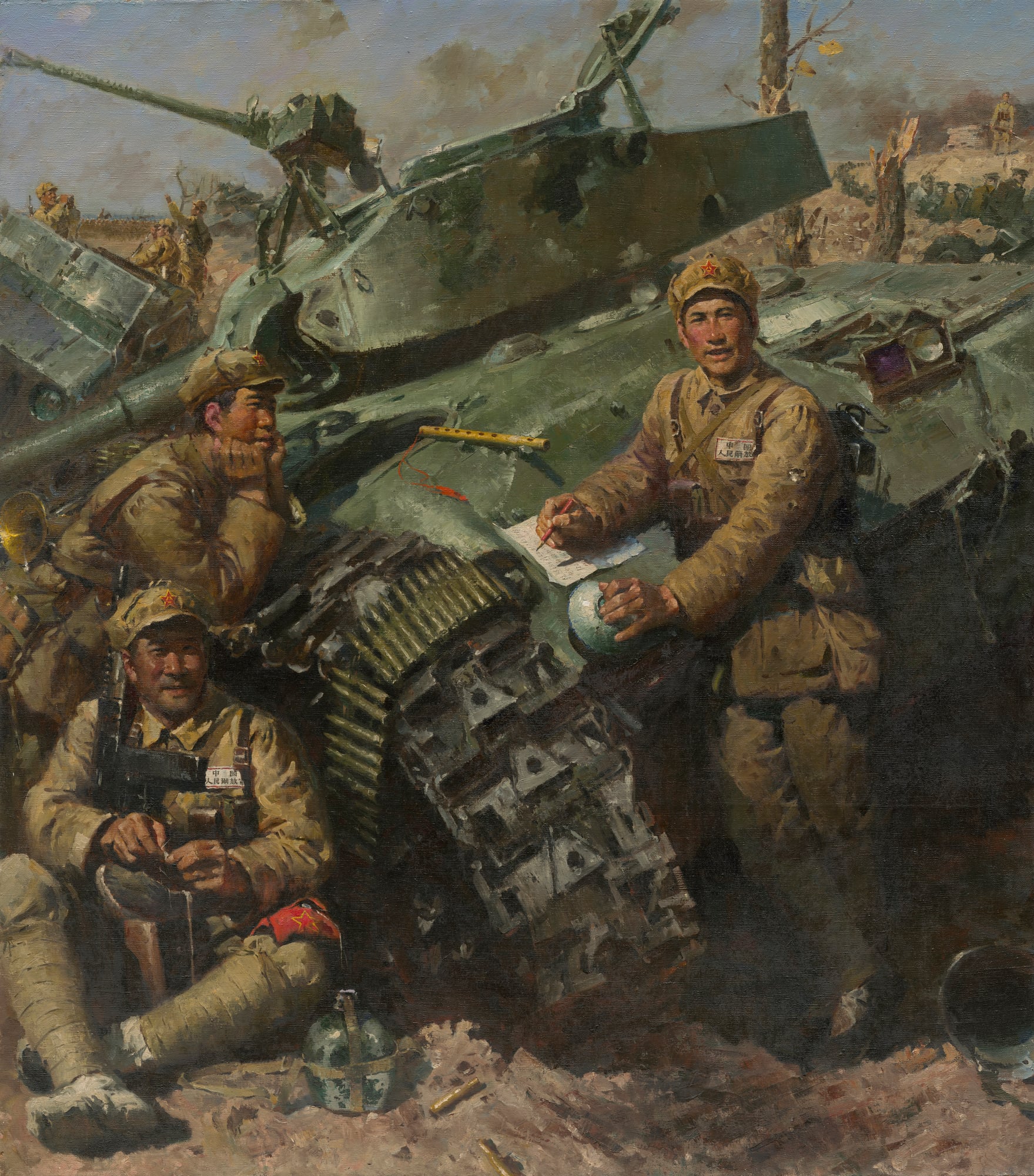
The beginning of a work of art is not always a carefully planned idea. Sometimes, it begins with a chance encounter.
That was how Song of the Warrior, an important early work by artist Yim Mau-Kun, came into being.
On that occasion, Yim traveled from Zhaoqing to Guangzhou not to begin a new painting, but to retrieve one that had been rejected in Beijing.
At the time, Yim worked in stage design for a theatrical troupe in Zhaoqing. He was also one of the relatively few artists in the area capable of producing large-scale figurative paintings. Local cultural authorities had previously assigned him to create a historical painting about General Ye Ting and his connection to Zhaoqing. After the work was completed, it passed reviews at both the local and provincial levels and was sent to Beijing, only to be returned.
So Yim went to Guangzhou to collect the painting.
It was during this seemingly disappointing trip that another work quietly began to take shape.
Among a Pile of Materials at the Guangzhou History Museum
At the time, Guangdong Province was preparing for a major art exhibition and had brought together a number of promising artists from different parts of the province to work in Guangzhou.
Their temporary base was the Guangzhou History Museum.
The museum’s exhibits had been moved out, and the interior was reorganized into a place where artists could live, work, and discuss their paintings together. Some were working on figurative subjects; others were producing large-scale thematic works.
Young artists who were beginning to attract attention, including Chen Yanning, were also working there.
Yim, however, had not formally come to join this group.
He happened to be in Guangzhou because his own painting had been returned.
While at the museum, he noticed a pile of materials that had not yet been cleared away.
There were newspapers and illustrated magazines.
Among them, an issue of PLA Pictorial caught his eye.
Color printing was still relatively uncommon at the time, and publications such as PLA Pictorial were not as readily available as ordinary newspapers. Yim remembered seeing a color photograph inside: a large American tank that had been destroyed.
Decades later, he still remembered his instinctive reaction.
He pulled the image out and slipped it into the shoulder bag he was carrying.
He later described the act as a kind of artist’s “conditioned reflex.”
It was not that he already knew what he was going to paint.
He simply saw an image that interested him and instinctively thought:
Perhaps I can use this.
Bringing the Tank Photograph Back to Zhaoqing
The journey from Guangzhou back to Zhaoqing took two or three hours at the time.
Yim returned to the theater troupe with the tank image still in his bag.
That evening, after washing up and settling down, he took out the materials he had brought home. The tank caught his attention again.
Gradually, an idea for a composition began to form.
Working in a theater gave him access to resources that an ordinary studio painter might not have had. There were actors, costumes, props, and all kinds of materials used in stage production.
He began asking actors from the troupe to pose as references and started making sketches.
The tank in the photograph was only a piece of military machinery. But the painting he envisioned would also need people.
The poses of the figures, their gestures, their relationship to the tank, and the rhythm of the overall composition all had to be imagined.
One detail from Yim’s recollection of the painting process is especially vivid.
He remembered painting while tapping his hand against a sheet of metal, beating out a rhythm.
He painted, kept the rhythm, and hummed as he worked.
The composition gradually emerged from that sense of movement and sound.
Eventually, the painting was given a title:
Song of the Warrior.
From Theater Artist to a Young Painter Gaining Recognition
Looking back today, it is easy to assume that an award-winning painting naturally belonged to the career of a professional artist.
But Yim was not yet a full-time painter working freely in a private studio.
His official job was in stage design.
The troupe needed scenery. Productions had to be mounted. Someone had to take responsibility for the visual side of the stage, and Yim was essential to that work.
In fact, he only later discovered that provincial art authorities had once sent notice inviting him to join the group of artists working together in Guangzhou.
He had never received the notice.
While visiting the Guangzhou History Museum, he happened to run into Yan Wenxi, a fellow graduate of the Guangzhou Academy of Fine Arts.
Yan casually asked him:
“When are you coming to report?”
Yim was confused.
“Report for what?”
Yan told him that Yim’s name was supposed to be on the list of artists participating in the exhibition preparation group.
When Yim returned to Zhaoqing and asked about it, he learned that the provincial notice had indeed arrived, but the theater troupe had not released him.
The reason was very practical: he was the troupe’s main visual artist. If he left for Guangzhou, there would be no one to handle the scenery and stage design required for upcoming productions.
The episode reveals something important about Yim’s circumstances at the time.
On one hand, he was already beginning to attract the attention of the provincial art establishment.
On the other, he remained a salaried theater employee who had to find room for serious artistic work around his everyday responsibilities.
Song of the Warrior emerged from precisely that period of his life.
Song of the Warrior Wins First Prize
After it was completed, Song of the Warrior was sent to Guangzhou for a provincial art exhibition.
According to Yim’s recollection, the painting quickly attracted attention from fellow artists and judges.
It ultimately received First Prize.
Another First Prize went to Breaking Ground by Hu Yichuan, then president of the Guangzhou Academy of Fine Arts and an important figure in modern Chinese art.
The prize money was 20 yuan.
By today’s standards, that number sounds very small. But at the time, it was significant.
Yim recalls that his monthly salary was approximately 40 yuan.
In other words, the 20-yuan prize was equivalent to about half a month’s wages.
For a young artist still earning a fixed salary from a theater troupe, the award was not merely symbolic. It was tangible recognition.
More important than the money, however, was what the award represented.
Yim’s work was beginning to be recognized within a broader artistic circle.
Song of the Warrior was subsequently reproduced in the literary and arts journal Guangdong Literature and Art.
Before long, that same issue of the journal would play a role in another pivotal moment in his life.
From Guangdong Literature and Art to an Entrance Permit from the Central Academy of Fine Arts
Later, when the Oil Painting Department of the Central Academy of Fine Arts in Beijing resumed recruiting graduate students after the Cultural Revolution, Yim decided to apply.
There were no digital portfolios or online submissions.
One of the clearest pieces of evidence he had of his artistic achievements was the issue of Guangdong Literature and Art in which his work had been published.
He mailed the entire journal to Beijing as part of his application materials.
The Central Academy accepted his application.
Soon afterward, an examination permit arrived in the mail.
For a young artist who had been designing stage sets in a local theater troupe while pursuing painting whenever he could, this represented entry into an entirely different world.
Song of the Warrior had helped bring him to the threshold of one of China’s most prestigious art academies.
But in the end, he did not go to Beijing.
He returned the examination permit.
That is another story.
How One Rejected Painting Led to Another
Perhaps the most intriguing part of the story of Song of the Warrior lies in the chain of events that preceded it.
If Yim’s earlier historical painting about Ye Ting had not been rejected in Beijing, he might never have made that particular trip to Guangzhou to retrieve it.
Without that journey, he might not have been at the Guangzhou History Museum at that moment.
And without standing beside that pile of discarded or soon-to-be-cleared materials, he might never have noticed that issue of PLA Pictorial.
He might never have pulled out the photograph of the tank and slipped it into his bag.
One rejected painting unexpectedly became the starting point for another work that would win recognition.
Decades later, when we discuss an artist’s career, what usually remains are titles, dates, exhibitions, and awards.
But the true life of a painting often begins in moments that seem insignificant at the time:
a rejected work,
a journey home,
a pile of old printed materials,
a photograph noticed by chance,
and the instinct of a young artist reaching out to save an image that caught his eye.
Someone else might have seen only an old photograph.
An artist saw the possibility of a painting that had not yet been made.
That was where Song of the Warrior began.