
My Father Went to Taiwan, We Stayed in Hunan
In 1949 Yim Mau-Kun's father left for Taiwan while the family stayed in Hunan. What seemed a brief separation quietly became permanent.
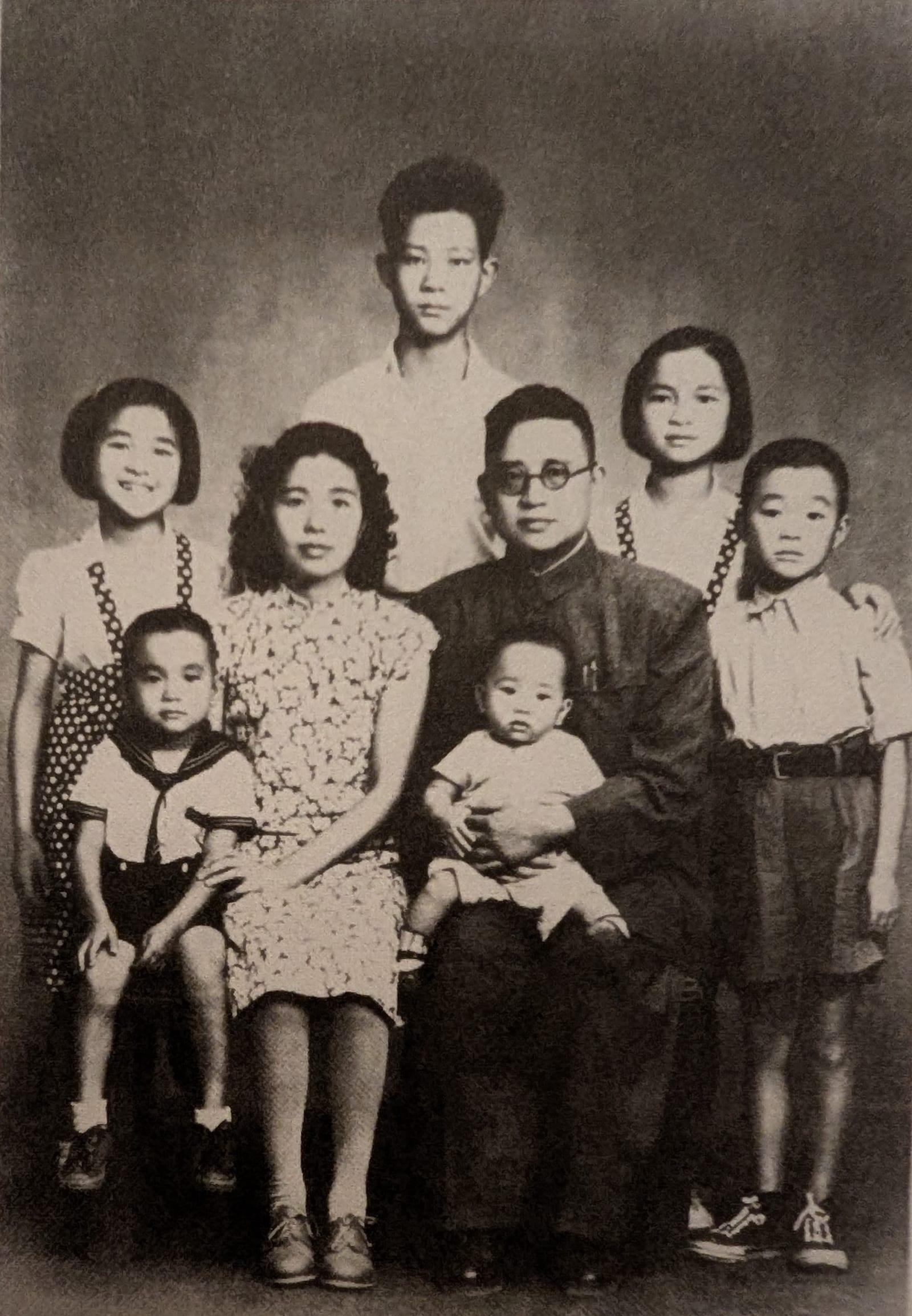
In 1949, Yim Mau-Kun was still a child.
Many years later, when he looked back on that period of his life, much of the detail had already blurred. Which houses they lived in, when different relatives moved from one place to another—some of the sequence could no longer be reconstructed with certainty.
But one thing remained clear:
His father went to Taiwan, while the rest of the family stayed in Hunan.
That separation became an important turning point in Yim Mau-Kun's childhood and family life.
His Father Thought He Would Come Back
When Yim Mau-Kun's father, Ran Peng, went to Taiwan, he did not intend to leave his wife and children behind permanently.
Years later, the family learned from the diaries he left behind that his original plan had been to go to Taiwan first, settle his work and living arrangements, and then return to the mainland to bring his family over.
To him, it seemed simply a matter of sequence.
He would go first.
His wife and children would remain behind temporarily.
Once he was settled, he would come back for them.
But after he arrived in Taiwan, the political situation no longer allowed him to return.
What had been expected to be a temporary separation simply continued.
The Family Was Divided Within Hunan as Well
After Ran Peng left, the family members who remained in Hunan did not all continue living together.
Yim Mau-Kun had four older siblings: his two older brothers, Ran Maohua and Ran Maoxun, and his two older sisters, Ran Maoquan and Ran Maoling.
The four older children remained in Changde.
The two younger boys, Yim Mau-Kun and his younger brother Ran Maoxin, went with their mother, Huangfu Dao'an, to the countryside in Taoyuan to stay with her family.
So the father was in Taiwan.
The four older children remained in Changde.
And the mother took the two youngest sons to rural Taoyuan.
This was not a long-term arrangement the family had carefully planned. It developed gradually amid the upheaval of the years around 1949.
As a young child, Mau-Kun could not have fully understood why the adults made these arrangements.
He only knew that his father was gone, his older brothers and sisters were staying in Changde, and he and his younger brother were going to the countryside with their mother.
The Ran Family Had Already Fallen on Hard Times
The Ran family still had some old houses in Changde.
Third Uncle, Third Aunt, and other relatives had lived there, although some of them later moved to the countryside in Taoyuan as social conditions became increasingly unsettled.
When Yim Mau-Kun spoke about this family history late in life, he made one point clear: by the time land reform began, the Ran family no longer owned much land.
There were many people in the household. In earlier years the family had also supported nannies, servants, and others, so daily expenses were substantial.
Much of the family property had already been sold off before what was then called “Liberation.”
As he remembered it:
Whatever could be sold had been sold.
So when his father left, Huangfu Dao'an did not have much property of her own to fall back on.
It was her family in Taoyuan that still retained some land.
His Mother Took the Two Boys to Taoyuan
Huangfu Dao'an's family came from Taoyuan, Hunan.
The Huangfu family had once been a relatively prominent scholarly household in the county seat.
Their old residence was deep and expansive, with one courtyard leading into another. Yim Mau-Kun later described the layout as a series of connected spaces, “one after another.”
It was a large household, and the family had also collected old books.
But by 1949, the Huangfu family's circumstances had declined considerably.
One of his mother's brothers had gone to Sichuan relatively early and worked in a university library or a similar position. Another remained in the countryside in Taoyuan and became the uncle Yim Mau-Kun remembered most clearly from childhood.
His mother eventually took Mau-Kun and Maoxin to stay with relatives in the Sanyanggang area.
Nearby was the place that would appear again and again in his later memories:
Shigutan.
From Changde to the Countryside
Yim Mau-Kun later said that his memories from before the age of six or seven were quite indistinct.
His first truly clear childhood memories began at Shigutan.
It was completely different from Changde.
Rolling hills.
Rice fields.
A small river.
Ponds.
Timber-and-tile houses.
Cowsheds.
And a group of cousins close to his own age.
His mother and the two boys crowded into a rural compound with his uncle's family.
For the adults, it was a difficult period.
But children remember life differently.
Decades later, when Yim Mau-Kun spoke about the year he spent in the countryside, he could still say:
That year in the countryside was actually quite fun.
His Mother Supported the Children with Her Own Hands
His father was far away in Taiwan, and his mother had very little money.
In the countryside, Huangfu Dao'an had to rely on the skills she already had.
She knew how to make clothes.
So she began sewing for local farming families.
There were no sewing machines available to her.
Everything had to be cut by hand and stitched by hand.
She would go to farmers' homes and make clothes for them, stitch by stitch. In return, she could earn a little or simply have food for herself and her child.
Yim Mau-Kun remembered that:
whatever the farming family was eating, his mother would take him along, sew clothes for them, and eat there with them.
It is a small detail, but it says more about their circumstances than a broad description of hardship ever could.
Her husband was in Taiwan.
Her four older children remained in Changde.
She had taken her two youngest sons into the countryside.
There was no steady income.
No one knew what the future would look like.
So she relied on what she knew how to do and kept the family going.
The Children Quickly Learned Country Life
The adults had practical problems to solve.
The children saw a different world.
Yim Mau-Kun quickly began learning rural tasks from his cousins.
In the summer, he helped with simple farm work.
When there was no work to do, the children caught fish, shrimp, and loaches, gathered firewood, and ran along the riverbanks and through the fields.
These experiences became some of the clearest memories of his childhood.
For that reason, Shigutan was never only a place of hardship in Yim Mau-Kun's memory.
It was also where he first became deeply familiar with the natural world.
He would later remember the waterwheels, rice fields, river, fish and shrimp, and the many people who lived and worked around the village.
Those memories became an important part of the stories he told about his early years in Hunan.
A Child Does Not Understand What “Unable to Return” Means
Looking back today, we know that 1949 marked a profound historical divide.
A child at the time would not have understood it that way.
For Yim Mau-Kun, his father's departure for Taiwan was not initially a political event.
It simply meant:
his father was no longer at home.
The adults may have understood war, political transition, and the growing separation across the Taiwan Strait.
A child did not.
If he was told:
Your father has gone to Taiwan first. Once he is settled, he will come back for you.
Then what a child understood was simply that he had to wait.
Wait for his father to return.
Wait for the family to live together again.
But the days passed.
His father did not come back.
His mother and the two younger boys continued living in Taoyuan.
His older brothers and sisters remained in Changde.
Gradually, the family became accustomed to living in different places.
His Mother Became the Center of the Life That Remained
At Shigutan, the people and things Yim Mau-Kun saw every day were his mother, his uncle, his cousins, farmers, fields, and the river.
The world his father inhabited gradually disappeared from his daily life.
Communication was difficult in those years.
A child had no way of knowing what his father was doing each day in Taiwan, much less when he might be able to return.
After his father's departure, Huangfu Dao'an gradually became the central figure in Mau-Kun's childhood.
She too had grown up in an educated family, yet she now had to rebuild her life under completely different circumstances.
First she supported herself in the countryside by sewing clothes for local farmers.
Later, she found a way to return to Changde.
She attended training courses.
She took examinations.
Eventually, she became an elementary school teacher.
Because of her, Yim Mau-Kun was able to return to school as well.
He studied first at Lieshi Street Elementary School, then entered Changde No. 1 Middle School, and gradually found his way toward art.
A Family Background That Continued to Shape His Life
His father's move to Taiwan began as a family separation.
But as the political environment changed, the fact that “his father was in Taiwan” also became part of Yim Mau-Kun's official family background, affecting his education and later opportunities.
Years later, when he applied to a professional art school, that family background nearly became an obstacle to his admission.
In 1949, of course, he could not have understood any of this.
He knew only that his father had left, his four older siblings remained in Changde, and he and his younger brother had gone to the countryside with their mother.
Only many years later did Yim Mau-Kun learn from his father's diaries that Ran Peng had always intended to come back for the family. Once in Taiwan, however, circumstances no longer allowed him to return.
The family's dispersal had not been carefully planned.
It developed step by step as circumstances changed.
Yim Mau-Kun went on to spend his youth in Hunan. He returned from Taoyuan to Changde, continued his schooling, began to draw, and eventually left Hunan to pursue professional art training.
Many years later, after living in Hong Kong, he too eventually arrived in Taiwan.
By then, his father had already died.
Looking back, 1949 remained a clear turning point in his childhood.
From that point on, his father was largely absent from everyday life, while his mother, Huangfu Dao'an, became the person who held the family together.
She took her two youngest sons into the countryside, supported them by cutting and sewing clothes for local farmers, and later returned to Changde to become a schoolteacher.
It was within the life she rebuilt that Yim Mau-Kun was able to return to school, continue his education, and eventually begin the path that led him to art.