
When a Scholarly Family Encountered Land Reform
Land Reform reaches a family that valued learning. The Huangfus are reclassified, the next generation becomes farmers, and Yim Mau-Kun takes a different road.
After 1949, Yim Mau-Kun followed his mother to the countryside of Taoyuan, Hunan.
His father had gone to Taiwan and, for the time being, could not return.
His mother took her two children to stay with her own family.
They settled in an area called Sanyanggang, and more specifically, in a place known as Shigutan.
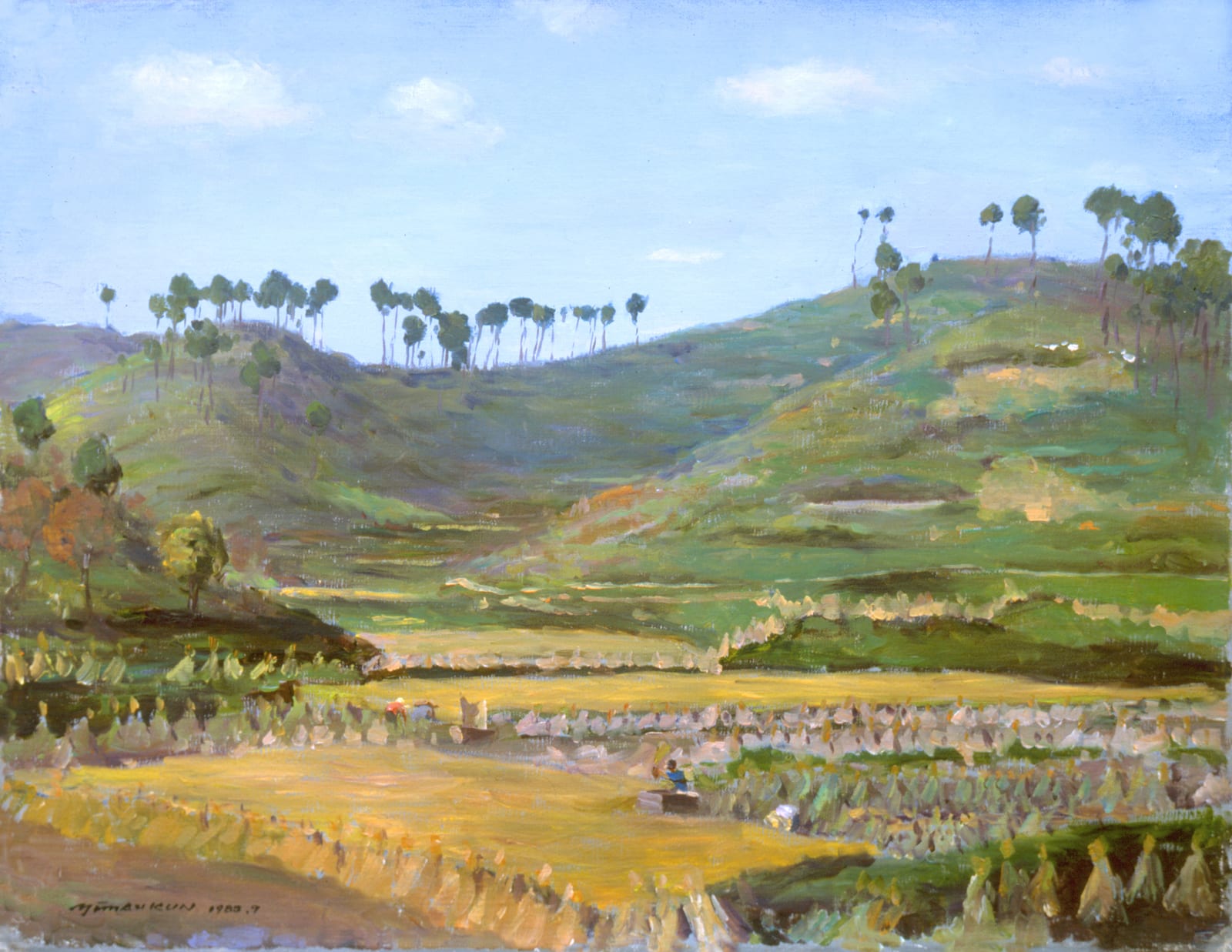
To six- or seven-year-old Mau-Kun, Shigutan was a world of streams and rice fields, cattle and timber houses, and cousins who became his childhood companions.
But for the adults, Shigutan was also at the center of another enormous transformation.
Land Reform had arrived.
And his mother's family, the Huangfus, found themselves on the side whose lives and property were about to be reclassified.
A Scholarly Family Already in Decline
Mau-Kun's mother, Huangfu Dao'an, was born in Taoyuan, Hunan.
The Huangfu family had not originally been an ordinary farming household.
In Mau-Kun's later recollections, his mother's family was one that placed great importance on education and learning.
They once had a traditional brick-and-timber family residence in the county town of Taoyuan.
His maternal grandfather loved classical books. The family was said to have owned a Ming-dynasty edition of the Twenty-Four Histories—not merely a few scattered volumes, but more than ten cases of books.
Many years later, Mau-Kun wrote in his manuscript that these books had been burned by the Peasants' Association during Land Reform.
But beside that passage he made a careful note:
This section has not yet been investigated.
It was a memory passed down through older members of the family, rather than something he himself could fully verify.
By the time his mother married, the Huangfu family had already fallen far from its earlier circumstances.
The old house in town remained, as did some farmland in the countryside, but the family's economic position was no longer what it had once been.
Under the new system of political classification, however, the fact that a family had owned land in the past could itself determine where that family would be placed.
His Uncle Was Classified as a “Landlord”
When Mau-Kun and his mother moved to Shigutan, his uncle Huangfu Daoyue and his family were living there.
His uncle still had some farmland.
In Mau-Kun's memory, it amounted to only a few mu of poor-quality land.
Yet when Land Reform began, Huangfu Daoyue was classified as a “landlord.”
There was a striking gap between that political designation and the uncle Mau-Kun remembered.
His uncle was hardly an experienced farmer.
He had been educated in town and had worked as a clerk or accountant for a commercial business.
He liked playing basketball.
He did not know how to transplant rice seedlings.
He did not know how to harvest rice.
He was unfamiliar with most agricultural work.
If there was one rural task he could manage reasonably well, it was tending cattle.
But Land Reform did not classify people according to whether they actually knew how to farm.
If a family owned land, it owned land.
The amount of land, the family's previous economic position, and its property relationships became important factors in determining political status.
And so the Huangfu family was placed into a new system of classification.
“Where Are the Gold and Silver Hidden?”
Mau-Kun remembered that during Land Reform, members of the Peasants' Association came to search his uncle's home.
They believed that a family like this must have gold or silver hidden somewhere.
So they forced their way in and searched through the house, looking for valuables.
A child might not have understood what words such as “landlord” or “class” really meant.
But he could see the fear of the adults.
He could also see that the house, the land, and the belongings that had once simply been part of a family's private life were no longer treated that way.
Everything could now be examined again.
How much land do you own?
Are you hiding money?
How did your family make a living?
Who were your ancestors?
Questions that had once belonged to family history had suddenly become political questions.
From Not Knowing How to Farm to Having to Become Farmers
Huangfu Daoyue's children were still very young at the time.
Mau-Kun and his cousins were mostly around seven or eight years old.
The adults were not skilled farmers.
But the children continued to grow.
And so they began learning from people who truly knew how to work the land.
Transplanting rice.
Harvesting grain.
Tending cattle.
Carrying loads.
Cutting firewood.
Doing whatever needed to be done in the fields.
Many years later, one of Mau-Kun's strongest impressions when he looked back at his cousins was this:
They really did become farmers.
Not farmers in name only.
They became people who knew how to do everything.
They could grow rice.
Harvest crops.
Raise livestock.
Do carpentry.
Even build their own houses.
He remembered that several of his cousins even made the mud bricks for their homes themselves.
After the autumn harvest, they would flood a field.
They would lead cattle through the mud, walking in circles until the earth became soft and fine.
Then they would cut the mud into blocks.
Dry them.
Carry them home.
And use them to build walls.
If a door or window broke, they repaired it themselves.
If the roof needed fixing, they did that too.
Within a remarkably short period, the next generation of a scholarly family that had once known little about farming had acquired an entire set of skills necessary for rural survival.
Mau-Kun Saw Another Life He Might Have Lived
In Mau-Kun's later memories, there was deep emotion attached to this part of the story.
He had once lived alongside these cousins.
They ran around Shigutan together.
Worked in the fields together.
Caught fish together.
They were only a year or two apart in age.
But eventually, their lives began to separate.
Mau-Kun returned to Changde to attend school.
Later, he entered Changde No. 1 Middle School.
Eventually, he was admitted to the affiliated secondary school of the Guangzhou Academy of Fine Arts. He left Hunan and began moving toward a life in art.
His cousins who remained in Shigutan and nearby Qingjiaping, however, became increasingly rooted in rural life.
When Mau-Kun saw them again after many years apart, he realized that they had become, in his words, “farmers through and through.”
There was sadness in the way he spoke about it.
He even found himself asking:
If those historic upheavals had not happened, shouldn't they have had the chance to study too?
In his mind, the answer seemed obvious.
Of course they should have gone to school.
But they did not.
Land Reform Changed More Than the Land
To a six- or seven-year-old child, Land Reform may initially have seemed like something that belonged to the world of adults.
People held meetings.
Homes were searched.
Families were reclassified.
Some people lost their land.
Only much later did Mau-Kun come to understand that what had changed was not simply the ownership of fields.
The direction of an entire family's life had also changed.
A family that had once valued education saw its next generation become farmers.
An uncle who had worked in town was redefined as a “landlord.”
For the children, continuing their education was no longer necessarily the natural next step. Instead, many entered agricultural life at an early age.
Family background itself acquired political meaning.
These changes did not all happen at once.
They were more like water slowly seeping into every part of life.
As the children grew older, they did a little more farm work.
Then a little more.
Eventually, some stopped going to school.
Within a few years, the old way of life had disappeared.
Another Side of Shigutan
And yet Mau-Kun's memories of Shigutan were not entirely heavy.
It was also the period of his childhood when he lived closest to nature.
A stream flowed down from the hills and formed a pool near his uncle's home.
Rice fields stretched along both sides.
There were trees on the hills.
Farmhouses were scattered across the rolling landscape.
In summer, the children could go into the water.
In autumn, they could catch fish.
During droughts, everyone worked the treadle waterwheels to irrigate the fields.
After the harvest, grain had to be carried toward the county town.
The adults were living through politics and the struggle to survive.
But what a child often saw instead was water, mud, fish, frogs, torchlight, and open fields.
Both kinds of memory existed at the same time.
That is one of the most striking aspects of the way Mau-Kun later wrote about Shigutan.
He did not remember it only as a place of hardship.
He even said that he did not feel the farm work had been especially bitter.
What remained in his memory were also many vivid and enjoyable scenes.
His Cousins Stayed Behind
Several decades later, Mau-Kun returned to Hunan.
By then, his uncle's family had moved from Shigutan to nearby Qingjiaping.
His cousins had built their own houses.
They were still living on that same land.
One evening, Mau-Kun traveled by car to visit them.
There were no streetlights in the countryside.
As the car made its way farther into the darkness, he saw three figures standing at a distant crossroads.
Each of the three brothers was holding a torch.
The flames moved in the darkness.
They were waiting for him to come home.
They were no longer the children who had once run through the fields beside him.
They were farmers now.
The family had prepared an entire table of food for him.
Even though Mau-Kun had told them in advance that he had already eaten dinner, no one had touched any of the dishes.
They had even ridden out especially to buy beer.
That evening, Mau-Kun and his relatives talked about the very different lives they had lived over the intervening decades.
He told them that they had endured many hardships in the countryside over the years, while he had been unable to do anything to help them.
He carried a sense of guilt about that.
Before leaving, he gave some money to his cousins and his aunt.
Not because the money could change what had happened.
But because, after so many decades, he was once again sitting face to face with the relatives with whom he had grown up.
A Family Whose Lives Were Rearranged
In modern Chinese history, “Land Reform” is an enormous political and social term.
But in Mau-Kun's memory, it was not first a historical term.
It was a family.
An old house in Taoyuan.
More than ten cases of ancient books.
A few mu of farmland.
An uncle who did not know how to farm and was mostly capable of tending cattle.
A group of children who might otherwise have gone to school.
And, many decades later, three farmers standing at a rural crossroads, holding torches as they waited for him to return.
History often describes people through categories:
Landlord.
Farmer.
Intellectual.
Cadre.
But in a child's memory, these people were family first.
An uncle.
A cousin.
A younger cousin.
People who ate together, slept under the same roof, worked in the fields, and played in the water together.
Land Reform changed the Huangfu family's property.
It also redirected the lives of the next generation.
Mau-Kun eventually left Hunan and moved toward school, toward art, and toward a completely different life.
His cousins remained on the land.
Decades later, when he looked back, he still found himself wondering:
If that enormous upheaval had never happened, what might they have become?
There can no longer be an answer to that question.
What remains are the river and rice fields of Shigutan—and the people who seemed so ordinary in his childhood, only to be understood much later as lives profoundly altered by history.