
My Mother: The Night She Said Guanyin Saved Her
From a single portrait unfolds the life of his mother, Huangfu Dao'an: wartime flight, separation across the Taiwan Strait, land reform, and the night at Shigutan she said Guanyin saved her.
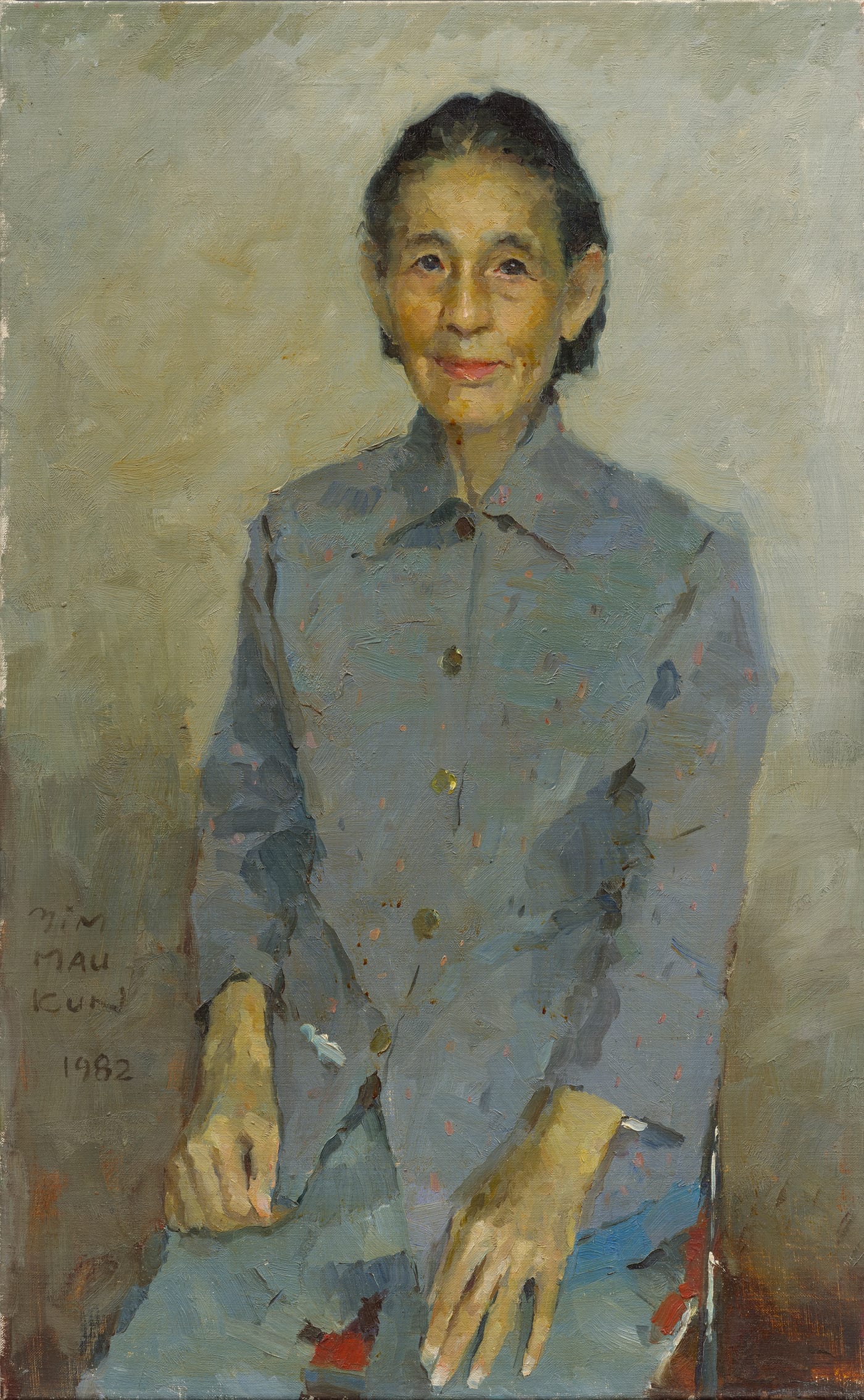
In his earlier years, Yim Mau-Kun painted a portrait of his mother.
In the oil painting collection in which the portrait was later published, he wrote a short account of her life. It began simply:
My mother's name was Huangfu Dao'an. She was from Taoyuan County, Hunan.
What followed condensed almost an entire lifetime:
her education,
her marriage,
wartime displacement,
her separation from her husband after 1949,
land reform,
a night at Shigutan,
and, many years later, a question she asked her son near the end of her life:
Mau-Kun, was your mother great?
From Zhounan Girls' School to Daxia University
Huangfu Dao'an was born into an educated family in Taoyuan, Hunan.
The Huangfu family also conducted business and owned property in Changde. Her father loved books, and the family had collected old editions of classical works.
In another memoir, Yim Mau-Kun recalled that the family had once owned an original edition of the Twenty-Four Histories. He wrote that the books were later burned during land reform, although he also carefully noted beside the passage that this detail had “not yet been investigated.”
There was also a more remarkable figure in his mother's family.
In a family letter that reached them circuitously in 1963, Yim Mau-Kun's father, Ran Peng, wrote to Yim's elder brother, Ran Maohua, about his mother's maternal grandfather, He Laibao.
His assessment of He Laibao was unequivocal:
the most learned and the youngest among Changde's revolutionaries who died for the cause in the late Qing!
He Laibao was a close friend of Tan Sitong, one of the martyrs of the Hundred Days' Reform, and died during the anti-Qing Self-Supporting Army uprising of 1900.
Huangfu Dao'an received a substantial education for a young woman of her generation.
She attended Zhounan Girls' School in Changsha.
Later, seeking to escape a marriage arranged by her family, she left for Shanghai and enrolled at Daxia University.
It was in Shanghai that she married Ran Peng and left university.
During the war against Japan, the family fled with other people from their home region, eventually making their way to Chongqing to escape the advancing Japanese forces.
In the text accompanying his mother's portrait, Yim Mau-Kun referred broadly to “the six of us brothers and sisters.” According to the family history documented so far, Ran Peng had six children in total. Ran Maoxun was the son of his first wife, and another child died during wartime flight from the Japanese invasion.
The end of the war did not bring lasting stability.
In 1949, another separation began—one that would last for the rest of his parents' lives.
1949: His Parents Were Separated Across the Taiwan Strait
In 1949, Ran Peng went to Taiwan.
His original plan was to settle there first and then return to bring his family over.
But after arriving in Taiwan, circumstances no longer allowed him to return to the mainland.
Yim Mau-Kun later wrote of his parents:
From then on, my parents were separated on opposite sides of the Taiwan Strait and never saw each other again before they died.
The children, too, gradually became dispersed.
The older children remained in Changde.
Huangfu Dao'an kept her two youngest sons, Yim Mau-Kun and Ran Maoxin, with her.
Her husband was gone.
Her children needed to be cared for.
She had to find a way to begin again.
In 1950, She Took Her Two Young Sons to Stay with Her Brother
The Huangfu family had done business and owned property in Changde.
After the Communists entered the city, Huangfu Dao'an's parents felt that Changde had become too unsettled and moved to the countryside in Taoyuan.
Around 1950, Huangfu Dao'an also took her two young sons—Yim Mau-Kun and Ran Maoxin—to rural Taoyuan to stay with her younger brother.
They lived in the Sanyanggang area.
Nearby was Shigutan, a place that would appear repeatedly in Yim Mau-Kun's childhood memories.
His uncle had been educated in the city and had worked in accounting or similar commercial positions. He was not, by background, a farmer.
But the family still had a few fields in the countryside.
In his manuscript, Yim Mau-Kun described his uncle directly as a:
small landlord.
When land reform began, his uncle was seized by members of the local peasant association.
He was tied up.
Suspended and beaten.
They demanded that he reveal whether the family still possessed gold, silver, or other valuables.
But by then, Yim Mau-Kun recalled:
Our family had already fallen on hard times.
His Grandmother Drowned Herself
The fear created by land reform soon entered the family itself.
Huangfu Dao'an's mother became deeply frightened.
She eventually drowned herself.
At the time, Huangfu Dao'an's husband was already in Taiwan. She was living in the countryside with two young sons, while her younger brother was being subjected to political struggle.
Now her mother was dead as well.
In an earlier memoir, Yim Mau-Kun described his mother's reaction in only a few words:
Mother was stunned into silence.
Not long afterward, Huangfu Dao'an herself went toward the water.
In the Middle of the Night, His Mother Was Gone
One night, the young Yim Mau-Kun suddenly woke.
He reached out for his mother beside him.
She was not there.
He immediately woke his uncle.
Realizing something was wrong, his uncle lit a torch, took a bamboo pole, and hurried toward the water.
By the light of the torch, they could see someone still floating there.
It was Huangfu Dao'an.
His uncle rushed toward her, calling:
Sister!
Using the bamboo pole, he managed to pull her from the water.
Yim Mau-Kun remembered his uncle holding her and crying:
Sister, don't do something foolish!
She eventually regained consciousness.
For the rest of his life, Yim Mau-Kun remembered several images from that night:
the empty place where his mother had been sleeping,
the darkness,
the torch,
the surface of the water,
and his uncle calling out, “Sister.”
“It Must Have Been Guanyin Who Came to Save Me”
Years later, Huangfu Dao'an told her son that she too remembered something from that night.
In the text accompanying her portrait, Yim Mau-Kun wrote:
She told me that the bottom of the water had looked very bright. She was certain that Guanyin Bodhisattva had come to save her.
Later, she kept a piece of long cigarette-box wrapping printed with an image of the seated Guanyin.
She attached it to a wooden pillar in the simple school dormitory where she lived.
It remained there for years.
In Yim Mau-Kun's memory, his mother's attachment to that small image was very direct.
She believed that somehow, on that night, she had been brought back from the water.
In the Countryside, She Survived by Sewing
After she was rescued, daily life still had to continue.
Huangfu Dao'an had no steady income.
But she knew how to cut and sew clothing.
So she began making clothes for local farming families.
There was no sewing machine.
Everything was cut and stitched by hand.
Yim Mau-Kun remembered that his mother would take him with her to farmers' homes while she worked.
Whatever the family ate, they ate as well.
She used her sewing skills to obtain enough to keep going.
The children, meanwhile, followed their cousins into rural life—helping with farm work, catching fish, shrimp and loaches, and gathering firewood.
This was part of the life mother and sons shared in rural Taoyuan.
Back in Changde, She Became an Elementary School Teacher
Eventually, Huangfu Dao'an returned to Changde with the children.
She needed work that could provide a more stable livelihood.
She attended training courses and took teaching examinations.
Eventually, she became an elementary school teacher.
In the text accompanying her portrait, Yim Mau-Kun summarized this period in a single sentence:
As the children grew up and scattered to different places, Mother applied to become an elementary school teacher. She kept my younger brother and me with her, and we lived through difficult years together.
Mother and sons later lived at Lieshi Street Elementary School in Changde.
Yim Mau-Kun returned to school.
There he met teachers such as Liu Jiazhen and Mei Hanxin and began to engage more seriously with drawing.
Later he entered Changde No. 1 Middle School, joined the art group, and eventually left Hunan for professional art training.
Before he became an artist, his mother had first rebuilt a life in which he was able to continue his education.
She Was Often in Poor Health
Huangfu Dao'an was not physically strong.
Yim Mau-Kun wrote:
She was frail and frequently ill. She underwent several operations and once fainted at the front of the classroom while teaching.
Even so, she continued working as an elementary school teacher for many years.
Her salary was modest.
She had a family to support.
Yet during floods, she still gave from that small income to help disaster victims.
The lessons she gave her children were similarly simple.
Yim Mau-Kun remembered her telling him:
Your handwriting should be neat.
She also taught him that writing should be clear and well ordered,
and that one should treat others with honesty and kindness.
These were things he remembered throughout his life.
What They Had Waited For Was News of His Father's Death
Huangfu Dao'an never saw her husband again after their separation.
Yim Mau-Kun wrote:
We waited and waited. Then, in 1978, what finally came was the terrible news that Father had died in Taipei.
Ran Peng died in Taipei in 1978.
From their separation in 1949 until his death, husband and wife never met again.
In 1980, Huangfu Dao'an received permission to go to Hong Kong.
Five years later, her younger son accompanied her to Taipei.
At last, she stood before her husband's grave and offered incense.
The husband she had waited decades to see was no longer there.
Only his grave remained.
Four years later, Huangfu Dao'an, her eldest daughter's family, and Yim Mau-Kun's family all moved to Taipei.
For the first time in many years, members of the family were again living in the same place.
Not long afterward, she became seriously ill.
“Mau-Kun, Was Your Mother Great?”
The family took Huangfu Dao'an to Chang Gung Memorial Hospital in Keelung.
Doctors told them that her organs were failing.
Yim Mau-Kun later admitted that he was extremely busy at the time and did not initially understand how serious her condition had become.
One day he went to see her.
Her hands were cold.
He sat beside her, rubbing them to warm them.
Then she suddenly asked:
Mau-Kun, was your mother great?
He froze.
For a moment, he did not know how to answer.
Finally, he said:
Let's not use the word “great.” You have been an extraordinary example for us.
His mother said nothing more.
She simply patted the back of his hand.
“My Great Mother”
After Huangfu Dao'an died, the family held a simple funeral service in Keelung.
Yim Mau-Kun wrote:
I cried so hard I almost choked.
In the text accompanying her portrait, he addressed his mother directly:
Mother, how much hardship you endured!
He remembered her modest salary.
He remembered that even with so little, she had still helped flood victims.
He remembered her teaching him to write neatly, to express himself clearly, and to make kindness and integrity the basis of how he treated others.
And then he wrote:
My great mother.
This time, he finally used the word she had once asked him about.
“They Will Have Endless Tang Poems and Song Lyrics to Talk About”
After his mother's death, the family restored Ran Peng's grave.
They opened his coffin and placed Huangfu Dao'an's urn inside.
Yim Mau-Kun was very specific in his manuscript:
They placed it beside his father's shoulder.
Then he ended the account with a single line:
They will have endless Tang poems and Song lyrics to talk about…
They had both grown up in educated families.
In 1949, they were separated across the Taiwan Strait.
They never saw each other again.
She remained behind and raised the children.
He died in Taiwan.
Years later, she was finally able to stand before his grave.
And after her own death, their children placed her ashes beside him.
Yim Mau-Kun did not add anything more.
Only:
They will have endless Tang poems and Song lyrics to talk about…