
Shigutan: My Early Appointment with Nature
His father gone, his family scattered — yet at Shigutan the young Yim Mau-Kun formed his earliest memories of nature: a river, rice fields, turtle fishermen, and summer waterwheels.
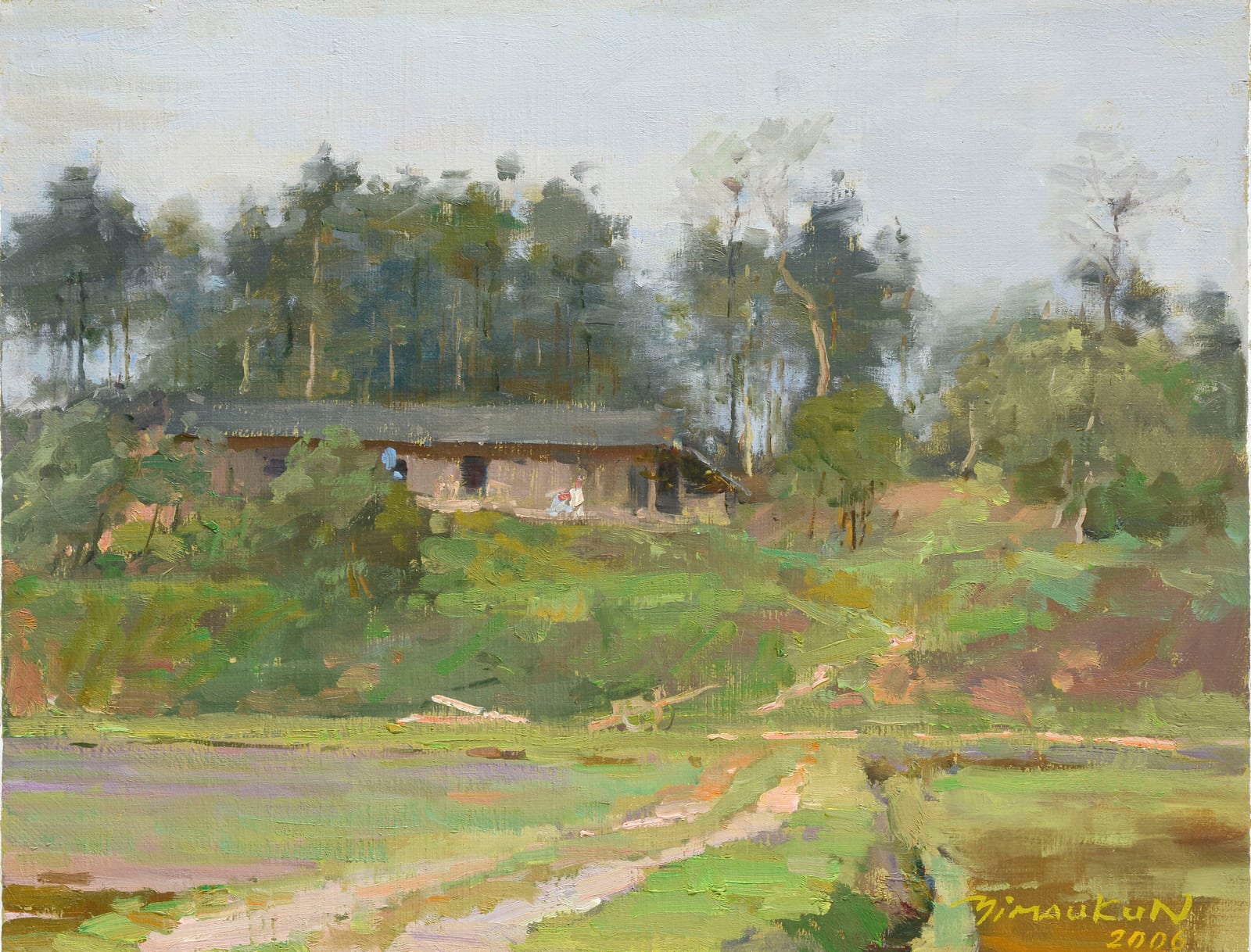
Late in life, while organizing his childhood memories, Yim Mau-Kun once said with a smile:
I had an appointment with nature very early in life.
That “appointment” began at Shigutan, in Taoyuan, Hunan.
He said that much of his life before the age of six or seven had faded from memory. Of the places where he lived around 1949, only fragments remained.
His first truly clear childhood memories began at Shigutan.
There was a small river.
Rice fields.
Rolling hills.
Cattle.
Fish.
Frogs and turtles.
And a group of children who followed the adults into the fields, then ran off whenever they had time to explore the riverbanks and hills on their own.
Many years later, Yim Mau-Kun became an artist.
But long before he received any formal art training, Shigutan had already given him an intimate experience of the natural world.
From Changde to the Taoyuan Countryside
Yim Mau-Kun's mother, Huangfu Dao'an, was born into an educated family from Taoyuan, Hunan.
The Huangfu family did not live only in the countryside.
They also conducted business and owned property in Changde. Yim's maternal grandfather loved books, and the family once collected a considerable number of old texts. Yim later remembered the Huangfu family as having a strong scholarly tradition.
A family letter sent circuitously from Taiwan in 1963 offers another glimpse into that background.
In the letter, Yim's father, Ran Peng, wrote to his eldest son, Ran Maohua, about an earlier generation of the Huangfu family.
He mentioned Huangfu Dao'an's maternal grandfather, He Laibao, describing him as:
the most learned and the youngest among Changde's revolutionaries who died for the cause in the late Qing!
According to Ran Peng's letter, He Laibao was a close friend of Tan Sitong, one of the martyrs of the Hundred Days' Reform, and died during the anti-Qing Self-Supporting Army uprising of 1900.
This comes to us through Ran Peng's family correspondence. It also suggests that the Huangfu family's scholarly tradition may have been connected to the broader political and intellectual world of late-Qing Hunan.
By around 1949, however, the family's way of life was changing rapidly.
Yim Mau-Kun's father went to Taiwan.
The Huangfu family had businesses and property in Changde, but after the Communists entered the city, Huangfu Dao'an's parents felt that conditions there had become too unstable. They left Changde and moved back to the countryside in Taoyuan.
Huangfu Dao'an, meanwhile, took her two young sons—Yim Mau-Kun and his younger brother Ran Maoxin—to rural Taoyuan to stay with her younger brother.
The older siblings remained in Changde.
For the six- or seven-year-old Mau-Kun, this was not a historical upheaval he could understand.
He simply followed his mother from a familiar urban life into an entirely different world.
His Memories Begin at Shigutan
Shigutan was located in the Sanyanggang area of Taoyuan, Hunan.
Huangfu Dao'an's younger brother and his family lived nearby.
The Shigutan of Yim Mau-Kun's memory was a typical landscape of the hilly Hunan countryside.
A small river wound down from upstream.
Terraced rice fields rose along both banks.
Near his grandmother's home, the river slowed at the foot of the hills and widened into a deeper pool. It then crossed a weir built with wooden piles and curved onward in the direction of Sanyanggang.
His uncle's family lived in a large timber-and-tile compound beside the hills and water.
At the center was a broad, level yard used for drying grain after the harvest.
There was a granary.
A cowshed.
Several households shared the compound.
His uncle's family occupied one of the side wings.
Huangfu Dao'an moved in there with Mau-Kun and Maoxin.
Mau-Kun was about six or seven years old.
Many years later, he wrote:
My memories beginning in 1949 start here.
An Uncle Who Had Never Really Been a Farmer
His uncle had not originally been a farmer.
He was educated, had worked in the city as a clerk or accountant, and enjoyed playing basketball.
The family still had a few fields in the countryside, but he himself knew little about farming.
Yim even remembered that the one rural task his uncle could probably manage best was tending cattle.
After land reform, however, the family's former way of life could no longer continue.
They had to depend directly on the land.
The adults had to learn how to transplant rice and work the fields.
The children learned alongside them.
At that age, Mau-Kun may not have understood everything that was happening to his family.
But the fields, the river, and the work that had to be done each day became very real parts of his life.
It was here that his clearest childhood memories began.
Even Seven- and Eight-Year-Old Children Worked in the Fields
Mau-Kun and his cousins were only seven or eight years old when they began following the experienced farmers into the fields.
Transplanting rice.
Harvesting grain.
Helping with farm work.
What is striking is that, decades later, he did not remember these experiences primarily as hardship.
Instead, he said:
Looking back today, I don't remember it as suffering. What remains are many interesting scenes.
For the adults, the fields were part of the family's livelihood.
For the children, they were also an enormous playground.
Catching Fish, Frogs, and Turtles
Water ran through nearly every part of Mau-Kun's childhood at Shigutan.
When there was no farm work to do, he and his cousins caught fish.
Frogs.
Turtles.
They gathered firewood in the hills.
They looked for mushrooms.
As the seasons changed, so did the things children could find and do.
After the autumn rice harvest, the water levels in rivers and ponds gradually dropped.
Fish, shrimp, and other creatures that had been hidden underwater became easier to see.
Farm households around the village often had their own ponds.
And every autumn, one particular visitor fascinated the children:
the fishermen who specialized in catching softshell turtles.
Following the Turtle Fisherman from Pond to Pond
Yim Mau-Kun remembered these fishermen vividly.
Whenever one arrived in the village, the children would immediately follow him.
The fisherman carried a specialized rod fitted with a reel, a small wheel, a lead weight, and a hook.
When he reached a pond, he did not cast immediately.
First, he looked.
Then he listened.
He tried to determine whether there were any turtles in the water.
Only if he thought there were would he sit down.
What happened next seemed almost like a performance to the children.
The fisherman rolled up his trouser legs and slapped the inside of his thigh with his hand.
Once.
Again.
Producing a hollow sound.
Yim remembered the adults saying that turtles were curious creatures.
When they heard the sound, they would slowly raise their heads above the water.
That was what the fisherman was waiting for.
The moment he saw movement, he flicked out the line.
The hook dropped into the water.
More often than not, he caught one.
The children watched from the side.
When one pond was finished, they followed him to the next.
Across the village.
Along the narrow paths between the fields.
On to another pond.
Laughing as they went.
Decades later, Yim still remembered this as one of the most entertaining sights of autumn at Shigutan.
No Watches—So They Used a Jar to Keep Time
The water at Shigutan was not only for play.
It was essential to farming.
If there was little rain in early summer, just when the early rice crop needed water, the farmers had to raise water from the pool to fields on higher ground.
Long waterwheels were set up along the riverbank.
One end extended into the water.
The other rose toward the higher fields.
Farmers stood on the wooden framework and continuously worked the pedals with their feet.
The wooden paddles lifted water step by step from below and emptied it into a higher channel or reservoir.
It was exhausting work.
So people had to work in shifts.
But in the countryside at that time, few people had watches.
The farmers had a simple solution.
Near the waterwheel's outlet, they placed a narrow-mouthed jar.
As the wheel turned, drops of water slowly fell into it.
Drop.
By drop.
When the jar was full, one shift was over.
And the person watching the jar was often a child.
Yim remembered the children staring closely at the rising water.
Almost full.
A little more.
Finally, full.
Then they would shout:
It's full! It's full! Time to switch!
The adults stopped.
Another group took over.
Standing beside the jar, the children felt almost like little supervisors.
Even Working the Waterwheel Could Become a “Festival”
If judged only by the labor involved, working the waterwheel was difficult.
Early summer was hot.
The farmers often worked bare-chested.
Their legs kept pumping the treadles.
Sometimes for long stretches at a time.
A white cloth might even be stretched over the wheel to provide shade.
But what Yim remembered was not only the physical strain.
He remembered singing.
One person would sing a line.
Someone on the other side would answer.
They sang back and forth as they worked.
They teased and joked with one another.
The children watched the dripping jar.
The adults worked the waterwheel.
Water climbed gradually toward the fields.
Songs, laughter, and the sound of the wheel mixed together.
Years later, Yim used an unusual word to describe the scene:
A festival.
Work that had to be done because of drought became, in a child's memory, a lively communal event.
In Autumn, Grain Had to Be Carried into Town
Autumn brought another kind of work.
Harvesting rice.
Gathering the crop.
And delivering the public grain quota.
Yim remembered that he and his cousins had to help.
The grain was packed into cloth sacks.
Loaded onto shoulder poles.
Then carried toward town.
For a young child, the journey was not easy.
Walk for a while.
Stop and rest.
Pick up the load again.
Walk some more.
They stopped many times before finally delivering the grain.
He also remembered the truly skilled farmers who lived in the compound.
Men from the Sheng family whom he remembered as “Granduncle Mao Six,” “Granduncle Se Eight,” and “Granduncle Nine” were exceptionally capable farmers.
Some strong adults could carry loads weighing as much as two hundred jin on a shoulder pole.
To a child, that strength seemed almost unbelievable.
Even a Braised Egg Was Too Precious to Eat
Life in the countryside also taught Yim Mau-Kun very early that food could not be taken for granted.
During the Lunar New Year period, he sometimes helped other farming families with small jobs.
When the work was done, they would invite him to eat.
New Year meals were better than ordinary meals.
There might be braised eggs.
Braised meat.
But Yim remembered that he often could not bring himself to eat everything.
He would save the egg or a piece of meat.
And take it home to his mother.
It is only a small detail from his oral history.
Nothing dramatic happened.
But precisely because it is so ordinary, it preserves something very real about a child's life in that period.
A piece of meat.
A single egg.
Neither was something to take for granted.
When he received something good to eat, his first thought was to bring some home.
“I Had an Appointment with Nature Very Early in Life”
Looking back many years later, Yim Mau-Kun knew that Shigutan had not simply been a happy childhood interlude.
His father had gone to Taiwan.
The family had been separated.
His mother's family was caught up in land reform.
The adults were facing very difficult realities.
But children remember selectively.
Alongside the family's hardships, the six- or seven-year-old Mau-Kun preserved another Shigutan.
A winding little river.
Terraced rice fields along its banks.
Turtle fishermen in autumn.
Waterwheels in summer.
A small jar slowly filling drop by drop beside the wheel.
Farmers singing as they worked.
Children waiting beside the jar until they could shout:
Time to switch!
There were fish.
Frogs.
Turtles.
Mushrooms.
Firewood.
Mud.
Rice grain.
These were among the first ways he came to know the world.
He had no idea then that he would one day become an artist.
Nor could he have known that decades later he would spend his life observing people, land, trees, mountains, rivers, and light.
He was simply running through the fields with his cousins.
Following farmers into the paddies.
Following the fisherman from pond to pond.
Squatting beside the waterwheel and watching one drop after another fall into a jar.
Late in life, when he looked back on those years, he gave that childhood experience a simple name:
I had an appointment with nature very early in life.
Perhaps for someone who would later become a painter, the earliest lessons in seeing did not necessarily take place in a classroom.
Before he learned how to hold a paintbrush, he had already learned to look.
To watch how a river bends.
How rice fields change with the seasons.
How a fisherman waits for the slightest movement on the surface of a pond.
How a farmer's legs drive a waterwheel.
How one drop of water after another can slowly fill a jar.
At the time, they were simply scenes from childhood.
Many years later, they became memories.