
Three Children in the Water
After a storm, three boys in the muddy city moat suddenly can't touch the bottom — a childhood brush with danger, and the first of the turning points when someone was there to pull Yim Mau-Kun back.
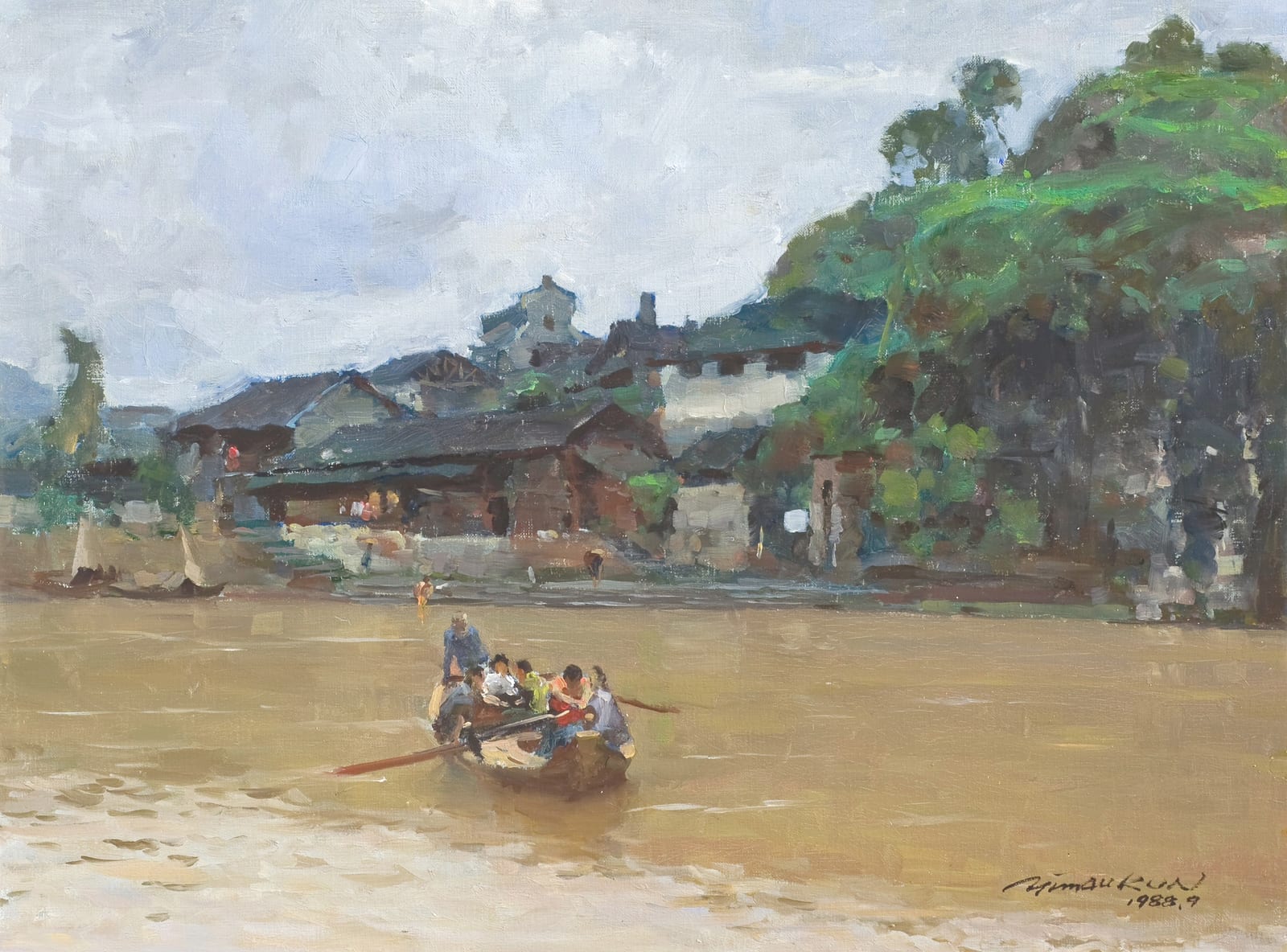
After returning to Changde from the countryside in Taoyuan, Yim Mau-Kun's life shifted once again—from fields and rivers back to the city.
His mother, Huangfu Dao'an, was also gradually establishing a more stable life.
She had initially worked as a substitute teacher and later became a regular elementary school teacher at Lieshi Street Elementary School in Changde.
The family lived at the school.
For the children, school was not only where they attended classes. It was also where they lived, and many of the children they grew up with were the sons and daughters of other teachers.
In summer, there was one thing the adults especially worried about:
the children running off to play in the water.
As Soon as Summer Vacation Began, the Children Headed for the River
In the early 1950s, whenever school closed for the summer, one of Mau-Kun's favorite activities was going to the water with the other children around Lieshi Street Elementary School.
There were rivers along the edge of Changde.
There were also waterways and sections of the old city moat.
For a group of elementary-school children in the summer heat, few things were more inviting than getting into the water.
The adults, of course, worried.
There were no swimming pools or safety facilities like those available today.
The children swam in natural waterways.
Some places were shallow.
Others were deep.
After heavy rain, the water level could change dramatically.
Every year, children were injured or drowned while playing in the water.
As both a teacher and a mother, Huangfu Dao'an certainly understood the danger.
But children do not necessarily stop doing something simply because adults worry about it.
Yim Mau-Kun remembered that during those early-1950s summers, he and several children from the Lieshi Street neighborhood often went swimming.
Usually, they came home perfectly happy.
Until one day, things nearly turned out very differently.
Three Children Found a Quiet Stretch of Water
There were three children that day.
They reached a relatively deserted section of the city waterway.
No one was around.
No adults were watching.
It seemed like the perfect place to get into the water.
But there had just been a heavy rainstorm.
The river they knew had changed.
The water was muddy from end to end.
The three children went in anyway.
Not far from where they were swimming was a small wooden boat.
It was the kind of double-oared boat commonly seen around Changde at the time.
Mau-Kun remembered that farmers from outside the city sometimes rowed these boats into Changde to collect night soil from households, which they then carried back to the countryside to use as fertilizer.
Perhaps the children regarded the little boat as something to swim toward.
But very quickly, they realized something was wrong.
Their Feet Could No Longer Touch the Bottom
Their bodies began to float.
They stretched their feet downward.
Nothing.
They could not touch the riverbed.
Only then did the three children become frightened.
The water was much deeper than they had expected.
After the rain, it was so muddy that they could not see anything beneath them.
There were no adults on the bank.
What had begun as playing in the water suddenly became a very different experience.
Mau-Kun was the youngest of the three.
In his panic, he managed to grab the heel of the child in front of him.
It was probably the only thing within reach.
But for the other child, suddenly having someone seize his foot underwater was just as frightening.
So he kicked.
And kicked.
Trying to shake Mau-Kun off.
One child desperately held on.
The other desperately tried to kick free.
Years later, Mau-Kun described the moment in one simple sentence:
I was absolutely terrified!
Finally, They Crawled Back onto the Bank
Yim Mau-Kun never wrote down exactly how long the three children struggled in the water.
Nor did he turn the story into some heroic tale of rescue.
He simply wrote:
Finally, we climbed back onto the bank.
All three were alive.
All three were out of the water.
Then they looked at one another.
There was probably very little to say.
A few minutes earlier, they had gone happily into the river to play.
Now all three understood that they had come very close to serious trouble.
Mau-Kun remembered how they looked:
We stared at each other, our hair standing straight up!
The sentence is almost like a cartoon.
Three soaking-wet children standing on the riverbank.
You look at me.
I look at you.
All three thoroughly frightened.
Their hair seemingly standing straight on end.
They Probably Said Nothing When They Got Home
Mau-Kun's manuscript does not say what happened after they returned home.
Did his mother find out?
Were the three children scolded?
Did they simply decide not to tell any of the adults?
He left no record.
So there is no need, decades later, to invent an answer.
What remained in his memory was simply:
the muddy water,
the little double-oared boat,
the sudden sensation of finding nothing beneath his feet,
and his hand desperately gripping another child's heel.
Children recover quickly.
Perhaps the next day they were playing again.
Summer vacation continued.
But some moments remain in memory for seventy years.
The People Who Gave Him a Hand at Turning Points
Late in life, when Yim Mau-Kun looked back over his past, he often thought about the people who had appeared at decisive moments and, in one way or another, “gave him a hand”—people whose actions changed the direction his life might otherwise have taken.
The childhood incident in the river was one such memory.
When his feet could no longer touch the bottom and he began to panic, there was another child just ahead of him.
Mau-Kun grabbed that child's heel and held on.
At the time, neither boy was thinking about fate or rescue. They were simply frightened children trying to get back to shore.
But looking back decades later, Mau-Kun could see that there had been moments in his life when someone happened to be there just when he needed them.
Years afterward, another such moment came when he applied for professional art training.
Because of his family background, his admission to the affiliated secondary school of the Guangzhou Academy of Fine Arts was uncertain.
According to Mau-Kun's later recollection, Hu Yichuan, then a senior figure at the academy, looked at the young applicant's work and photograph and said:
He's still just a child.
That decision allowed Mau-Kun to enter the school and receive the professional training that would shape the rest of his artistic life.
The circumstances were completely different.
One was a frightened child in muddy water.
The other was a young student standing at the threshold of an art education.
But in remembering his life, Mau-Kun often returned to these turning points—the moments when another person, sometimes almost by chance, helped move him onto a different path.
“Water and I Have Been Entangled All My Life!”
When Yim Mau-Kun wrote down this childhood story in 2021, he did not end with a reflection on danger or mortality.
He left only one line:
Water and I have been entangled all my life!
With that sentence, a childhood episode of nearly drowning connected itself to many later memories.
Shigutan in his childhood was water.
The waterways of Changde were water.
Later, as he left Hunan and traveled through different cities and landscapes, water continued to appear in the places he lived, observed, and painted.
But on that summer day, he was not yet the artist Yim Mau-Kun.
He was simply the youngest of three boys who suddenly discovered that his feet could no longer reach the bottom.
In the muddy water, he reached out in panic.
He grabbed another boy's heel.
The other boy kicked furiously.
But Mau-Kun held on.
Eventually, all three children made it back onto the bank.
They stood there.
Staring at one another.
Their hair standing straight up.
Many years later, the memory could still seem both frightening and slightly funny.
But it also belonged to a larger pattern he came to recognize when looking back on his life:
at several critical moments, someone had been there to give him a hand.