
Lieshi Street Elementary School: A Childhood Beside the Memory of War
Back in Changde, Yim Mau-Kun found his way back to study and drawing at Lieshi Street Elementary School — on a street named for the Battle of Changde, where his path toward art quietly began.
After leaving the countryside in Taoyuan, Yim Mau-Kun returned to Changde with his mother.
The rice fields, small river, waterwheels, and cousins of Shigutan gradually became part of another chapter of his life.
His new life began in an elementary school.
Changde Lieshi Street Elementary School.
His mother, Huangfu Dao'an, later taught there. Yim Mau-Kun completed elementary school there as well, and they even lived on the school grounds.
Many years later, when Yim looked back on his childhood, Lieshi Street Elementary School was more than a school. It was where his mother rebuilt a stable life, where he first took formal art classes, and where a child returning from the countryside found his way back to study and gradually toward drawing.
The street on which the school stood also carried the memory of a war experienced by the generation before him.
His Mother Found Work Again
When Huangfu Dao'an returned to Changde from the Taoyuan countryside, she still had no permanent job. Her husband was far away in Taiwan, and she had two young children to care for. She had to begin again.
Yim remembered that his mother first attended accounting-related training and later applied for training as a substitute elementary school teacher. She passed the examination and began teaching at Changde Lieshi Street Elementary School.
For the family, this was an important turning point. In rural Taoyuan, they had been staying with relatives. In Changde, his mother finally had work of her own, and the children returned to school. Their lives gradually began to take on a more settled shape.
The School Was Also Home
Lieshi Street Elementary School was not simply where Yim Mau-Kun went to class each day. Because his mother taught there, they also lived at the school.
The boundaries between classroom, teachers' quarters, campus, and home were therefore not very distinct. His teachers were also adults he encountered in daily life, and their children were his playmates. When classes ended, the school did not really “close.” It was still where they lived.
When Yim later recalled those years, he remembered more than sitting at a desk and studying. He remembered his mother preparing lessons, the teachers' desks, and the small ways he helped her with teaching materials while he was still a child.
When his mother taught younger pupils, she sometimes had to prepare a small blackboard the night before. Yim would draw on it for her:
Three apples.
Plus four more apples.
How many altogether?
At the time, he probably gave no thought to whether this had anything to do with his future as an artist. His mother needed a picture, so he drew one.
Why Was It Called “Lieshi Street”?
Many years later, when Yim talked about the school, he quickly turned to the name of the street itself.
His memory led back to the Battle of Changde during the War of Resistance Against Japan. In his late-life oral history, he no longer remembered the exact year or unit designation and himself said that those details “needed to be checked.”
According to surviving historical records, the Battle of Changde took place in 1943. The principal force defending the city was the 57th Division of the National Revolutionary Army's 74th Army, commanded by Yu Chengwan. About 8,000 defenders fought the Japanese forces inside the city for days and suffered devastating casualties; the 57th Division was nearly annihilated. Changde was temporarily lost and was later retaken in a Chinese counteroffensive.
After the battle, Changde began constructing a cemetery, memorial tower, memorial hall, and other facilities to commemorate those who had fallen. The memorial tower that survives today bears an inscription commemorating the officers and soldiers of the 57th Division, 74th Army, who died resisting Japan in the Battle of Changde.
Yim remembered that the monuments and cemetery were inscribed with the names of many fallen soldiers and also carried inscriptions by prominent figures of the Nationalist government. In his memory, the name “Lieshi Street” was closely connected with this whole landscape of postwar commemoration.
What remained clearest to him was not the unit number that had faded from memory in old age, but something simpler: the street where he lived and went to elementary school stood beside Changde's memory of that war.
A Child Growing Up After the War
The Battle of Changde was not a battle Yim Mau-Kun could personally remember clearly. By the time he attended Lieshi Street Elementary School, the fighting was over, but its traces remained throughout the city.
The name of the street.
The cemetery for the fallen soldiers.
The memorial tower.
The names carved on the monuments.
And the memories adults carried when they spoke about the troops who defended the city.
Children could pass these places every day without thinking about the war each time. Living on a street called Lieshi Street did not mean asking every day who the “martyrs” had been.
But the history was there. One generation had only recently lived through the fighting; the next was already studying, playing, and doing homework in the same city. Very little time separated the two.
Years Later, He Wanted to Paint the Battle of Changde
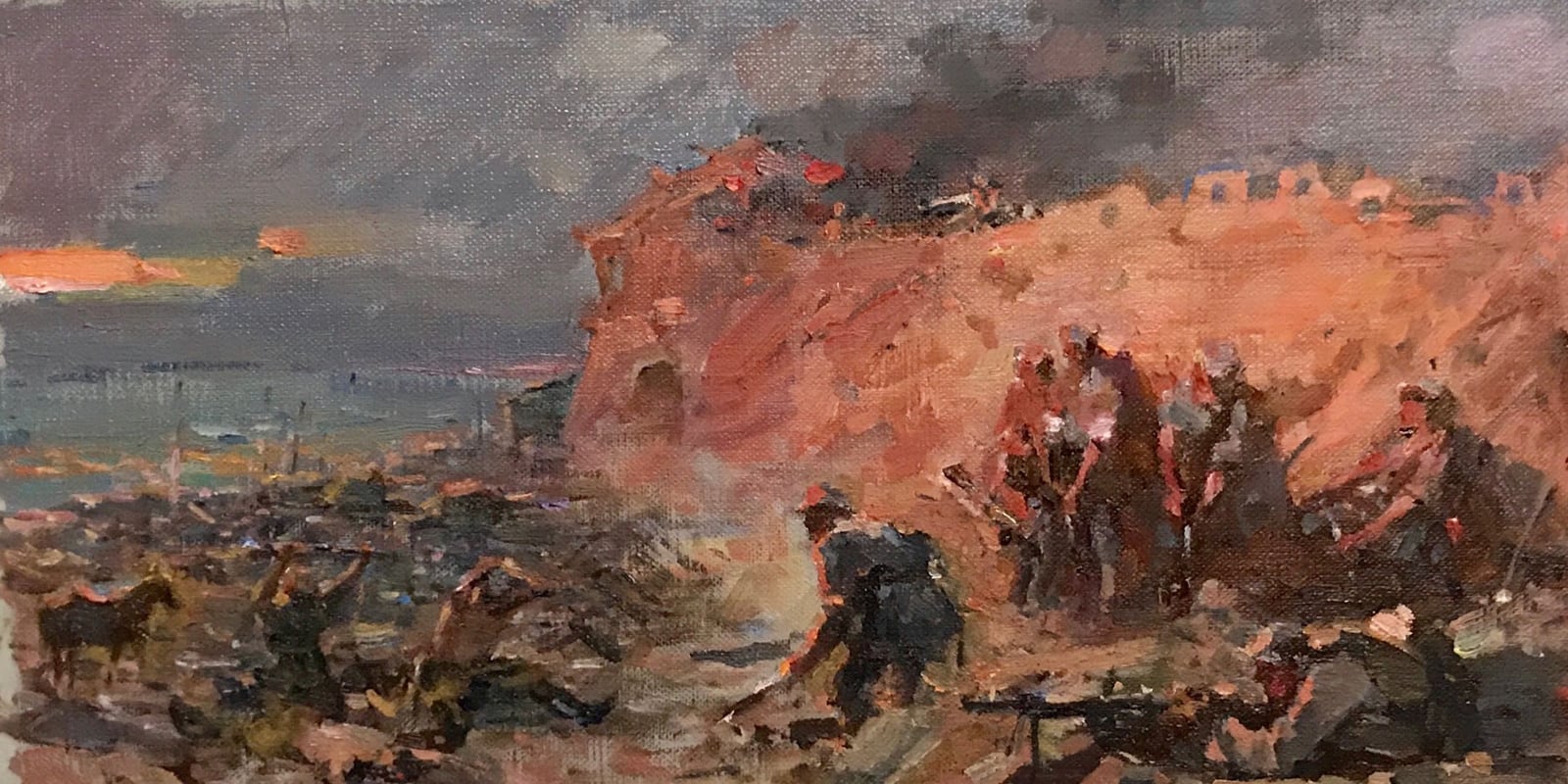
Because he had grown up beside this wartime memory, the Battle of Changde did not remain only a childhood association. Many years after becoming an artist, Yim planned a large-scale narrative oil painting on the battle.
To prepare for the work, he consulted extensive material on the battle, studying the figures, military uniforms, battlefield setting, and sequence of events. He also produced several color studies as he worked through the composition, relationships among the figures, and overall atmosphere.
But a painting on that scale required sustained time, physical stamina, and concentration. By the time he seriously organized the project, he was already advanced in age and ultimately could not complete the large-scale painting he had envisioned. The research material and color studies that remain record his late-life wish to revisit this part of Changde's history through painting.
From Country Child to Student Again
After returning to Changde, Yim Mau-Kun's life was completely different from life at Shigutan.
At Shigutan, he worked in the fields, transplanted and harvested rice, caught fish and frogs, and followed fishermen from place to place.
At Lieshi Street Elementary School, he sat at a school desk again.
Reading.
Writing.
Doing homework.
Taking art classes.
This change later became an important turning point in his life. Had he remained in rural Taoyuan, his life might gradually have resembled that of his cousins, growing into the life of a country child. But his mother returned to Changde, became a teacher, and brought him back into school with her.
From that point on, study once again became the center of his daily life.
His First Formal Art Classes
Late in life, Yim could no longer remember exactly what had been taught in his elementary-school art classes.
He wrote:
I have no memory at all of what we did in art class.
The line is strikingly candid. Because he later became a painter, he did not reconstruct every childhood art lesson as some kind of “artistic awakening.”
What he genuinely remembered were scattered details: a teacher showing them how to draw pencil still lifes, his own beginnings in figure drawing, and a picture that he later heard had been included in a Changde city art exhibition.
These fragments gradually became part of his earliest artistic experience. At the time, however, drawing was simply one part of school life.
Teacher Liu Jiazhen
The art teacher at Lieshi Street Elementary School, Liu Jiazhen, was someone Yim Mau-Kun still remembered many years later.
Liu was not formally trained at an art academy. Earlier in life he had worked in military radio communications, and later taught himself to draw and became the school's art teacher.
Yim remembered him as handsome and cultured. More importantly, he truly taught the children how to draw.
Pencil still lifes.
Figures.
Basic methods of drawing and constructing form.
Many years later, after becoming a professional artist, Yim still mentioned this elementary-school teacher who had never attended a professional art academy when recalling his earliest art education.
A first teacher does not always know how far a child in the classroom may eventually go.
Teacher Mei Hanxin
His homeroom teacher, Mei Hanxin, was another teacher Yim never forgot.
She, Liu Jiazhen, and Yim's mother Huangfu Dao'an all worked at the same school. To the young Mau-Kun, they were first of all simply teachers: adults who graded papers, cared for students, lived at the school, and helped one another.
Only many years later did he understand that each of these adults had a complicated life of his or her own. The later story of Teacher Mei and Teacher Liu became, in Yim's memory, another warm and bittersweet part of the past.
But at the time, he was still a child. Teachers were simply teachers.
An Unfinished Essay, My Mother
In his final year of elementary school, Teacher Mei Hanxin once assigned the class an essay topic:
My Mother.
Many years later, Yim returned to Hunan and visited the now elderly Liu Jiazhen and Mei Hanxin. Teacher Mei was around ninety, frail, and no longer able even to come downstairs.
When Yim finally began writing his memoirs late in life, he wrote an essay called My Mother. In the manuscript, he addressed Teacher Mei directly:
I still owe you the elementary-school graduation essay you assigned us: My Mother.
Several decades separated that elementary-school assignment from an old man in his eighties finally sitting down to write about his mother.
Some homework can be handed in very late indeed.
His Earliest Remembered Composition Also Began Here
Lieshi Street Elementary School left another small but revealing episode in Yim Mau-Kun's artistic development.
In the upper grades, he made a figure composition.
It was winter.
An elderly couple in padded cotton clothing walked along the street.
They carried a honglong, a traditional hand warmer used for heat.
They were on their way to a winter literacy class—a “winter school.”
He later heard that the picture had been shown in a Changde city art exhibition. Decades afterward, he called it:
My first composition, Going to Winter School.
As for how much of the image came from his own imagination and how much may have come from models or examples supplied by a teacher, he openly admitted that his memory had become unclear.
What matters is that he was no longer drawing only an apple or a cup. He had begun trying to use figures to tell a story.
His Mother, the School, and Drawing
Looking backward from the later career of Yim Mau-Kun, it is easy to search for the famous teachers and institutions.
The Guangzhou Academy of Fine Arts.
Professional drawing training.
Oil painting.
The professors and artists he later came to know.
But a little earlier, there was a much smaller beginning.
An elementary school.
A mother who taught there.
A small blackboard that had to be prepared at night for younger pupils.
Three apples plus four apples.
And Liu Jiazhen, a self-taught artist who became an elementary-school art teacher.
None of them were major figures in art history, but together they formed the environment in which a child first began to encounter drawing.
Growing Up on Lieshi Street
The name “Lieshi Street” carried the memory of the Battle of Changde, but for Yim Mau-Kun as a child, it was first of all the place where he lived: his mother's classroom, his own desk, the teachers' quarters, the children he played with, secret summer trips to swim in the river, and his first serious attempts to draw with a pencil. The city's memorials to war and the ordinary routines of childhood existed side by side on the same street.
When he returned from Shigutan to Changde, his life also changed direction there. His mother found stable work at Lieshi Street Elementary School, and he returned to school, gradually becoming not just a student but a child who loved to draw. Later he entered Changde No. 1 Middle School and eventually left Hunan for professional art training.
Many years later, when he planned a large narrative painting on the Battle of Changde, this part of the city's history that had surrounded him in childhood returned to his art. He researched the battle, studied the figures and battlefield environment, and produced several color studies. Although age ultimately prevented him from completing the large-scale painting he had envisioned, the project shows that Lieshi Street was more than a childhood address for him. It was also part of Changde's history that remained in his memory throughout his life.
And his own path toward art had quietly begun in that elementary school.