
Ganlu Temple: The First Painter I Knew
At a school converted from a temple, the young Yim Mau-Kun met Teacher Ouyang — the first person he ever knew as a 'painter.'
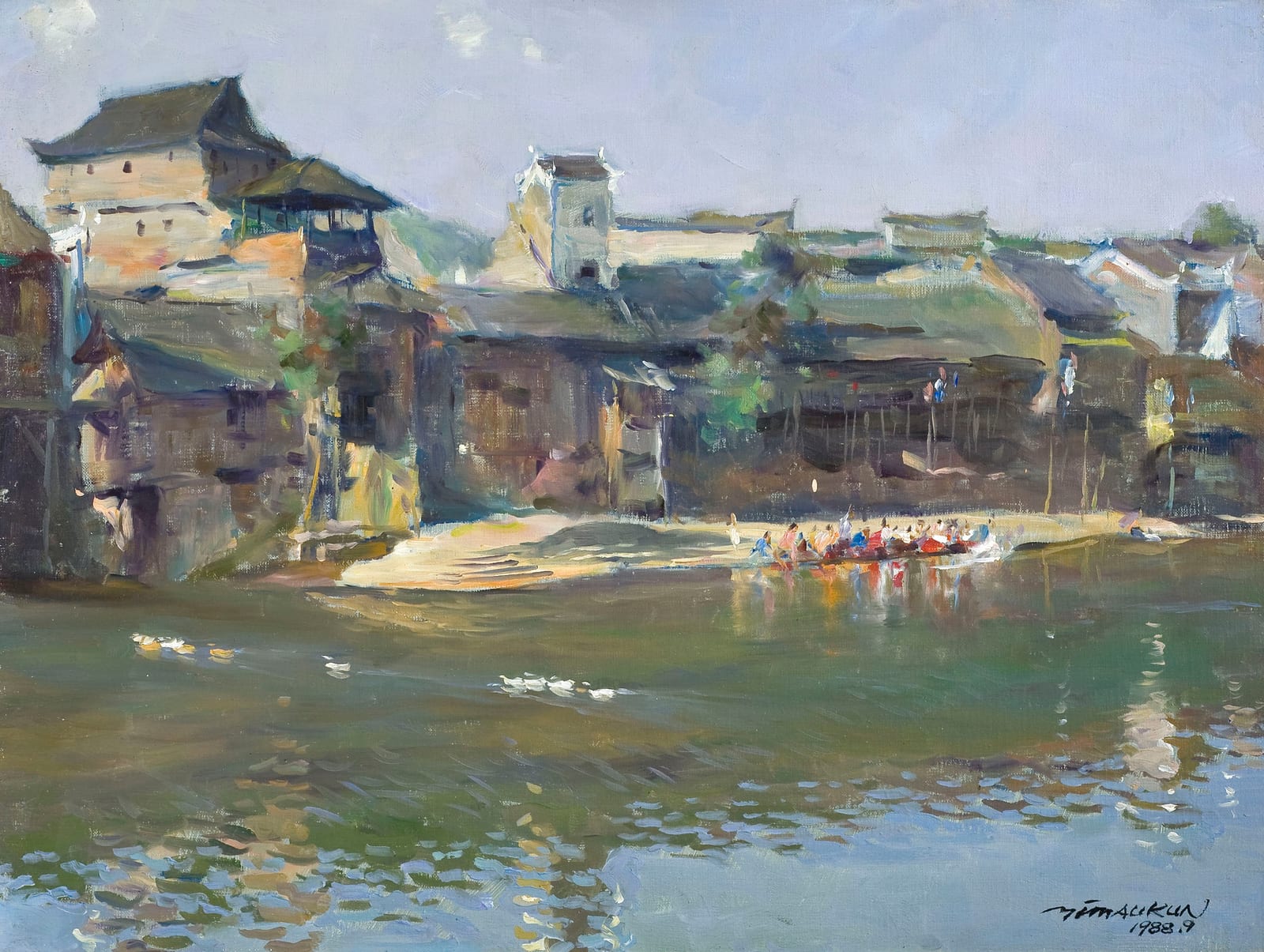
Late in life, when Yim Mau-Kun looked back on his childhood, he found it difficult to identify a single moment and say, “This was the day I began to love drawing.” He later attended art school, received professional training, and spent his life painting. But if we go back further—to a childhood before he fully understood what a “painter” was—one person remained clearly in his memory.
She was a woman teacher whose surname was Ouyang. He met her at Ganlu Temple Elementary School in Changde. Many years later, Yim wrote:
This was where I met the first painter I ever knew.
From Taoyuan Back to Changde
After leaving Sanyanggang and Shigutan in rural Taoyuan, Huangfu Dao'an brought her son back to Changde. She still had no permanent job, her husband was far away in Taiwan, and the family had to begin again.
At first, mother and son stayed in an old courtyard residence belonging to his eldest aunt. The place had fallen somewhat into neglect, with weeds growing through the yard and a high wall along one side. While caring for her child, Huangfu Dao'an looked for work that could support the family. She first attended an accounting course run by the local Federation of Industry and Commerce, and later entered training for elementary school teachers.
Before she eventually settled into a long-term teaching position at Lieshi Street Elementary School, she worked in several places. One of the schools where she stayed longer was Ganlu Temple Elementary School.
A School Inside a Temple
The Ganlu Temple Elementary School Yim remembered had originally been a Buddhist temple, already close to the outskirts of Changde. A few steps beyond the temple were rice paddies. There was no proper wall separating school from farmland—only shrubs and weeds. The temple buildings had become classrooms, with fields all around them.
The school was very small. Yim remembered only two or three teachers. His mother worked there, and he lived there with her. He had only recently left the rural life of Shigutan, and now he found himself in a temple school almost joined to the rice fields. The boundary between city and countryside still felt very thin.
Teacher Ouyang
Of the few teachers at Ganlu Temple Elementary School, the one Yim remembered most vividly was Teacher Ouyang. He remembered her permed hair, a pronounced Jiangsu-Zhejiang and Shanghai-area accent, and a loud voice—yet she always seemed to be smiling.
He later heard that Teacher Ouyang had studied art in Hangzhou and was a painter. For the young Yim, this may have been the first time that the identity of “painter” became attached to a real person in his everyday life. A painter was no longer someone in a book or a distant name. She was a teacher he saw every day.
Her Room Had “the Air of Painting”
Yim even remembered the room where Teacher Ouyang lived. It was an unremarkable old room, but something about its arrangement felt different to him as a child. Late in life, he wrote that the small details of the room:
Really had a certain “air of painting” about them.
He did not record what pictures hung there or describe the art materials in detail. He simply remembered that the room felt unlike other rooms. He did not yet understand what an artist's way of life might be, but he could already sense a difference.
Was She My Introduction to Art?
Many years later, Yim asked himself the same question: did Teacher Ouyang influence or awaken his later love of painting? He was not certain:
Was my love of painting influenced or awakened by her? I really can't find the source anymore…
He did not construct a neat story of a single “artistic awakening.” The fields of Shigutan, the apples his mother asked him to draw on small blackboards for her lessons, Teacher Ouyang at Ganlu Temple, Liu Jiazhen at Lieshi Street Elementary School, and later the art group at Changde No. 1 Middle School—all accumulated gradually. Looking back, it was impossible to separate one beginning from another.
But one thing remained clear: Teacher Ouyang was the first person in his memory whom he actually knew as a “painter.”
Teacher Ouyang Had a Daughter
Teacher Ouyang also had a daughter named Anmi. Yim remembered her as tall, beautiful, cheerful, and lively. Her mother was Chinese and her father was Italian. According to his recollection, after the change of government, Anmi's father returned to Italy, leaving Teacher Ouyang and her daughter behind.
And so, during those days at Ganlu Temple Elementary School, there were Huangfu Dao'an and her son Yim Mau-Kun, and Teacher Ouyang and her daughter Anmi, living at a little school converted from a temple, with rice fields just outside.
Looking back late in life, Yim also admitted that Anmi was the first girl to give him the faint stirrings of a childhood crush. What the two children actually said to each other—or whether anything that could be called a “story” ever happened—does not appear in his manuscript, and there is no need to invent a romance for them. What remained after seventy years was simply a name and an impression.
“Anmi! Where Are You?”
Yim eventually left Ganlu Temple. His mother found more stable teaching work, and he entered Lieshi Street Elementary School, followed by Changde No. 1 Middle School and the affiliated secondary school of the Guangzhou Academy of Fine Arts. Later came Guangzhou, Zhaoqing, Hong Kong, and Taiwan. Ganlu Temple remained behind in the Changde of the 1950s.
Where did Teacher Ouyang go afterward? What kind of life did Anmi lead? His manuscript gives no answer. Yet a few small images remained: the woman teacher with permed hair and a Jiangsu-Zhejiang/Shanghai accent, a room with a certain “air of painting,” the rice fields outside the temple, and the girl named Anmi.
So late in life, whenever he thought again of Ganlu Temple, he could still write one line:
Anmi! Where are you?!
Before He Truly Began to Study Art
Only a few years later did Yim begin formal art education: Liu Jiazhen taught him pencil still life; he joined the art group at Changde No. 1 Middle School; and eventually he traveled to Changsha to sit for the examination that led to his admission to the affiliated secondary school of the Guangzhou Academy of Fine Arts. These are the kinds of milestones that fit easily into an artist's formal chronology.
The memory of Ganlu Temple came before all of those “official beginnings.” At the time, Yim was simply a boy living with his mother in a school converted from a temple. There he met an unusual teacher and heard that she was a painter.
Was that his artistic awakening? Even late in life, he would not say for certain. Perhaps the best answer remained his own:
I really can't find the source anymore.
Some beginnings simply have no clear date. A child meets someone, walks into a room, senses that something there is different—and remembers that feeling for the rest of his life.