
Going to Winter School: Yim Mau-Kun's First Remembered Composition
An elderly couple with a warming basket, walking to an evening literacy class — the earliest 'composition' Yim Mau-Kun could remember. The original is lost; only the memory remains.
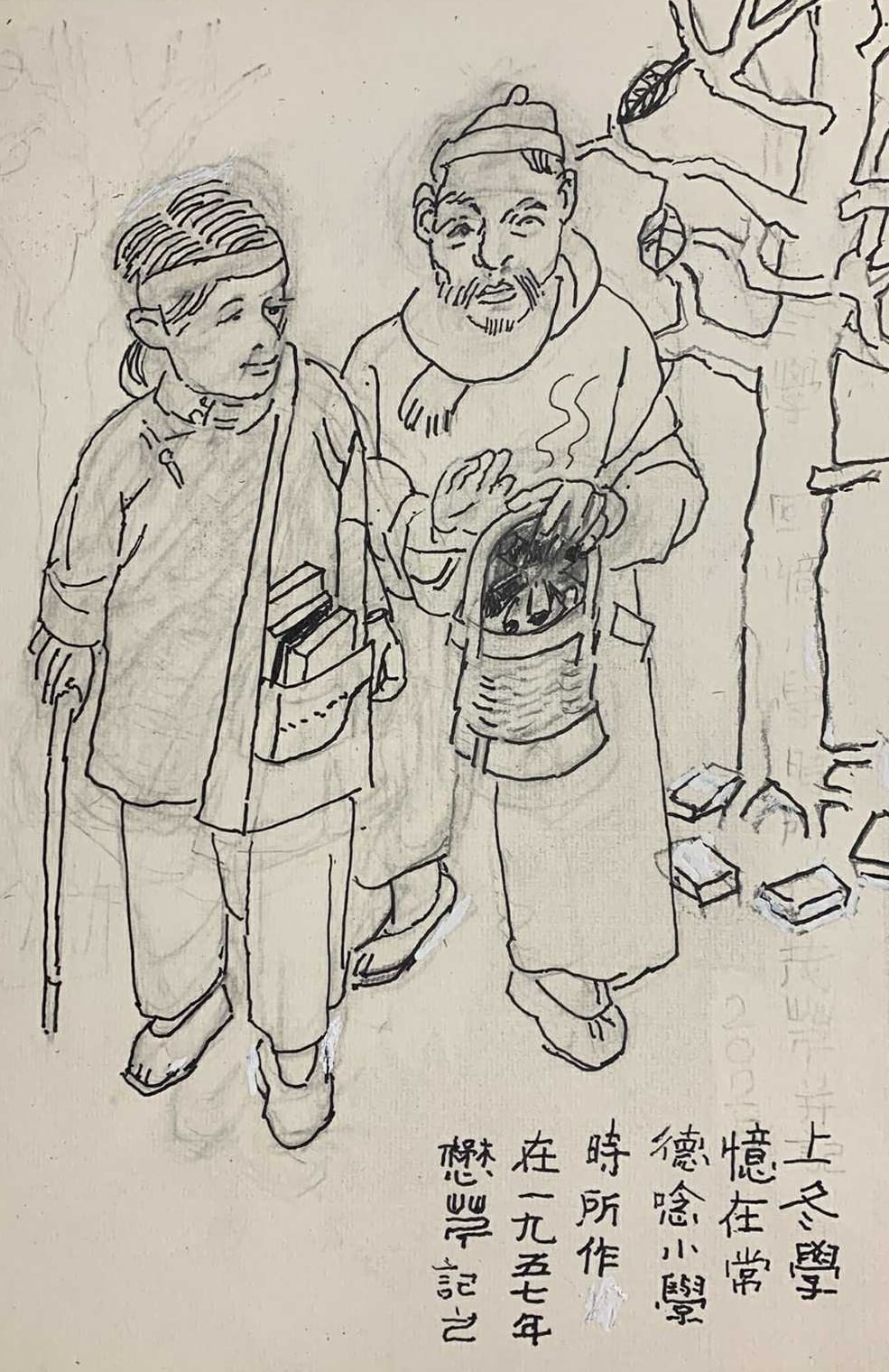
Many years later, when Yim Mau-Kun looked back over his artistic life, he tried to locate its earliest beginnings.
What was his first drawing? Who was the first teacher who truly taught him to draw? When did he first feel that he could depict people?
Many details had faded. But there was one picture he always remembered.
It showed a winter street. An elderly woman and an elderly man, both dressed in thick padded clothes, walked with canes and carried a bamboo warming basket for heat.
They were not going shopping or visiting relatives. They were going to class.
The picture was called Going to Winter School.
Years later, Yim described it as the first “composition” he could remember making.
What Was “Winter School”?
To readers today, the phrase “going to winter school” may sound unfamiliar. But when Yim was a child, many adults in both rural areas and towns had never had the opportunity to learn to read.
Winter was a quieter season for farm work, so some communities organized seasonal literacy classes where adults without formal schooling could learn to read and write in the evenings or during the agricultural off-season. These classes were called “winter schools.”
Yim remembered drawing an elderly couple on their way to one of these classes: an old man and an old woman in winter clothes, walking along the street with a warming basket in hand.
For an elementary-school child, this was already different from drawing an apple, a cup, or a table. The picture had people, movement, and something happening.
A Bamboo Warming Basket
When Yim spoke about the picture decades later, he clearly remembered the object carried by the elderly couple: a honglong, a portable warming basket used in winter.
The outside was woven from bamboo. Inside sat a small earthenware brazier containing charcoal and ash. It could be carried by hand for warmth.
In a Hunan winter, the sight of an elderly couple in padded clothes carrying a honglong on their way to literacy class would have been entirely ordinary. Decades later, as daily life changed, details like this became traces of another era.
What the child drew was not only two people. He also recorded a way of life that has largely disappeared.
It Was at Lieshi Street Elementary School
Yim drew Going to Winter School while attending Lieshi Street Elementary School in Changde. His mother, Huangfu Dao'an, was teaching there at the time, and the family lived at the school.
He completed elementary school there and also took his first formal art classes there. Yet by late in life, he remembered very little about exactly what those classes had taught.
In his manuscript, he wrote candidly:
I have no memory at all of what we did in art class.
Only a few fragments remained. One was that his teacher, Liu Jiazhen, had taught pencil still-life drawing. Another was Going to Winter School.
“If We Really Did Draw Figures…”
Yim did not describe this childhood work as more advanced than it probably was simply because he later became a professional artist. On the contrary, he remained cautious about his own memory.
He wrote late in life:
If we really did draw figures, there must of course have been some simple examples to work from.
That qualification matters. He was still only an elementary-school student. Going to Winter School may not have been conceived entirely from imagination. The teacher may have supplied figure examples or demonstrations, and the composition and poses may have reflected the art instruction of the time. Yim himself could no longer remember.
Rather than turning the picture into a story about a child prodigy creating his first independent masterpiece, it is more interesting to see it for what it may have been: a child beginning to use a picture to tell a story.
Three Apples Plus Four Apples
Even before he drew Going to Winter School, drawing had already found a quiet place in Yim's everyday life with his mother.
Huangfu Dao'an taught younger children at Lieshi Street Elementary School. When preparing lessons in the evening, she sometimes needed simple pictures on a small blackboard.
Three apples. Then four more apples. How many apples are there altogether?
Sometimes Yim drew them for her.
It was not “art” in any grand sense. He was simply helping his mother prepare for the next day's lesson. But pencil and image gradually became familiar parts of daily life.
First apples. Then still lifes. Later, two elderly people walking down a winter street.
Teacher Liu Jiazhen
Yim always remembered Liu Jiazhen, the art teacher at Lieshi Street Elementary School.
Liu had not received formal academic training in art. Earlier in life he had worked in military radio communications, then taught himself to draw and eventually became the school's art teacher.
Yim remembered him teaching pencil still lifes. The surviving material does not make clear how much direct guidance Liu provided for Going to Winter School. But by this period, Yim had begun receiving more systematic drawing practice, and Going to Winter School remained the clearest figure composition in his memories of those early years.
“I Heard It Was Also Shown in the City Art Exhibition”
When Yim wrote about Going to Winter School late in life, he mentioned one more detail.
He wrote:
I heard it was also shown in the city art exhibition.
In another oral account, he even remembered the work as having won an award at a Changde city exhibition. But in his manuscript, his wording was more cautious: “I heard.”
That difference is worth preserving. Memories of elementary school more than seventy years later can naturally exist in more than one version. The surviving material is not sufficient to determine whether the work was simply exhibited or actually received an award.
The more reliable point is that Yim remembered the picture leaving the school and entering a more public exhibition setting. For an elementary-school student, that alone would have been unusual: a drawing made for class might have been hung somewhere for other people to see.
He Did Not Yet Know He Would Become an Artist
As a sixth-grade student, Yim Mau-Kun had no idea where his life would eventually lead.
He did not know that he would enter Changde No. 1 Middle School, join its art group, travel to Changsha to take the entrance examination for the affiliated secondary school of the Guangzhou Academy of Fine Arts, or spend the next several decades painting figures, landscapes, portraits, and oils.
At the time, Going to Winter School was simply a picture made by a schoolboy.
Its subject was modest: two elderly people, a winter street, a warming basket, and an evening literacy class.
Yet looking back, one aspect of it is striking. He had chosen not merely a still life, but a scene from everyday life. The people in the picture were doing something. He already seemed interested in figures and stories.
A Painting That No Longer Exists
There is no evidence in the surviving records that Going to Winter School still exists. It was most likely lost long ago.
There is no photograph and no complete artwork record. Even Yim could reconstruct the image only from memory.
What remains, then, is not the object itself but the recollection: an elderly man in Taipei, decades later, remembering a winter in Changde, an elementary school, an art teacher, an elderly couple, and a phrase now rarely heard—“winter school.”
When people look at Yim Mau-Kun's mature work, it is natural to search for his artistic beginnings in technique, formal drawing, oil-painting training, and the academy. But before all of that, there was this lost picture.
It had no grand subject and no artist's ambition behind it. It was simply a child drawing a story he had seen or heard in the world around him.
Perhaps what matters most is not whether it was literally his “first” composition. What matters is that, by then, drawing had begun to mean more than copying an object.
He was beginning to use a picture to tell something that was happening.