
Liu Jiazhen and Mei Hanxin: Decades Later, I Still Owe My Teacher an Essay Called “My Mother”
Liu Jiazhen and Mei Hanxin were among the first to see Yim Mau-Kun draw. Returning to Changde decades later, he remembered an essay he had owed his teacher for a lifetime — 'My Mother.'
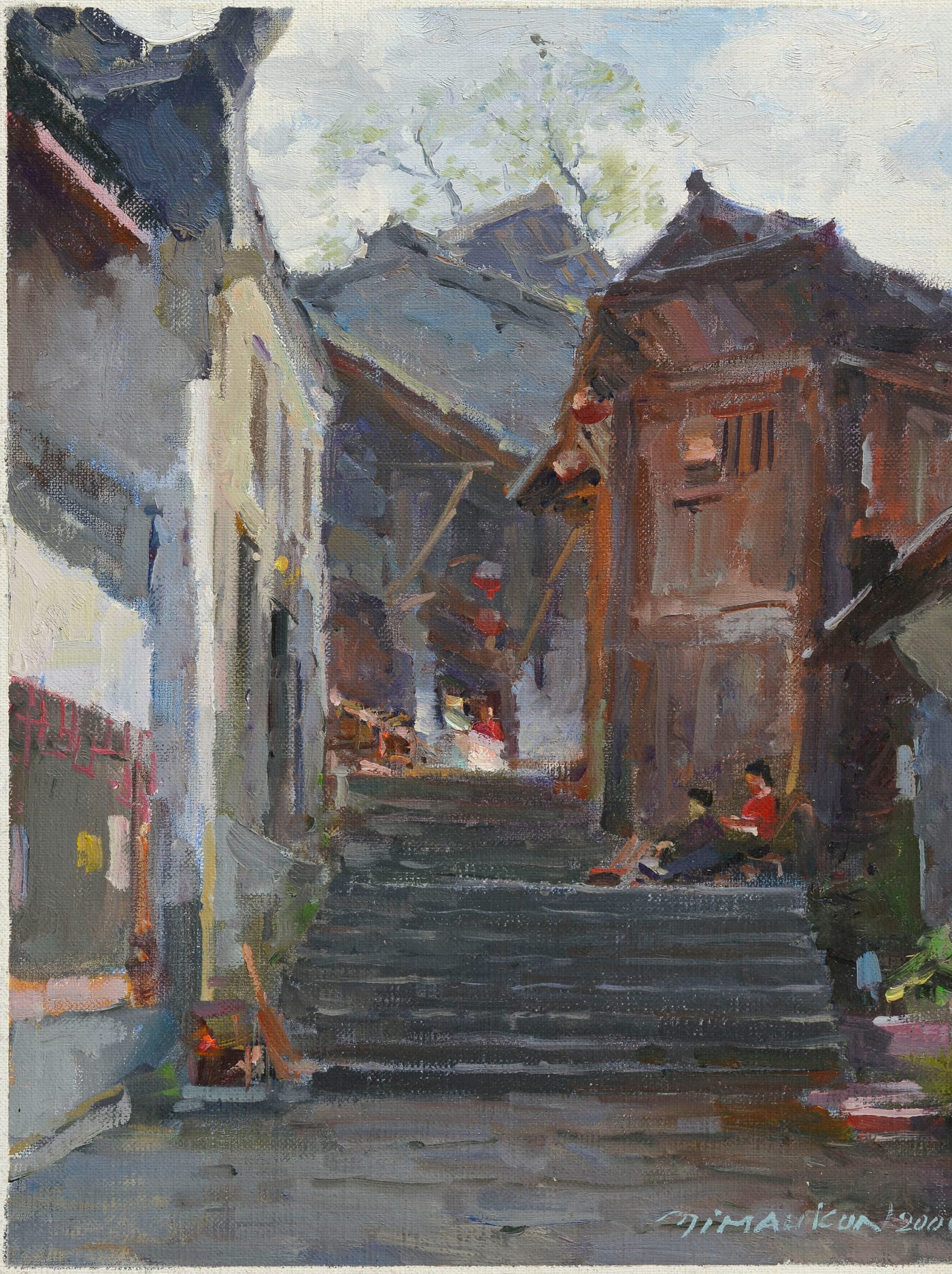
Late in life, when Yim Mau-Kun looked back on his years at Lieshi Street Elementary School in Changde, he remembered many teachers.
But there were two he still wanted to visit decades later.
One was his art teacher, Liu Jiazhen.
The other was his homeroom teacher, Mei Hanxin.
They were not famous figures in art history, nor were they professors from the art academy where Yim would later receive his professional training.
They were simply his elementary school teachers.
Yet many years later, when Yim once again climbed the old wooden staircase at Lieshi Street Elementary School and saw the two teachers, now white-haired and elderly, he realized that some teachers do not simply disappear with childhood.
An Art Teacher Without Formal Academy Training
Liu Jiazhen had not graduated from a professional art school.
According to Yim's recollection, Liu had worked in the military in his younger years as a radio communications operator. Later, he taught himself to draw and became the art teacher at Lieshi Street Elementary School.
Yim also remembered his appearance vividly. He repeatedly described Liu as “very handsome,” and in one late-life manuscript even joked that he could “charm every woman.”
But it was not simply his appearance that made Liu memorable.
Although he had never received formal art-school training, Liu genuinely knew how to draw and was willing to teach children. He taught pencil still life, taught students to observe, and encouraged the young Yim Mau-Kun to begin experimenting with figure drawing.
Yim later said that Liu's teaching was one part of his gradual move from simple copying and still life toward imagining figures and telling stories through pictures.
Desks Facing Each Other
Mei Hanxin was Yim Mau-Kun's homeroom teacher.
She had received formal teacher training, and her position at the school was more secure than that of some substitute teachers. She had three children and also cared for her elderly mother.
Yim remembered that Liu Jiazhen and Mei Hanxin sat at desks directly opposite one another in the teachers' office.
I faced you, and you faced me.
The two teachers often helped each other—grading students' papers, handling school matters, and looking out for one another.
At a small elementary school, teachers were not simply colleagues who went their separate ways when classes ended. Many lived on campus. They worked, ate, raised children, and spent much of daily life in the same place.
So for Yim, still an elementary school student at the time, the school was also a world in which he watched adults living their lives alongside one another.
Every Adult Had a Story of Their Own
Only after he grew older did Yim begin to understand that the teachers he had known as a child each carried complicated personal histories.
According to his recollection, Liu Jiazhen had once been close to a woman who had a child. Her husband had gone to Taiwan with the military, leaving her to remain on the mainland.
Mei Hanxin had her own family circumstances. Her husband had been the principal of another elementary school, but later lost that position, left the original household, and formed another family. More of the responsibility for raising the children and caring for her elderly mother therefore fell to Mei.
As these circumstances unfolded, Liu Jiazhen and Mei Hanxin grew closer.
Yim later recalled:
Liu Jiazhen came to treat Mei Hanxin's family as his own.
What mattered most in Yim's memory was that they cared for one another, and that this companionship endured for many years.
As a Child, He Did Not Understand Any of This
The young Yim Mau-Kun knew nothing about the complexities of the adults' lives.
Teacher Liu was his art teacher.
Teacher Mei was his homeroom teacher.
His mother, Huangfu Dao'an, was another teacher at the same school.
His daily world was homework, lessons, and art class.
Children see only a small part of adults' lives. Teachers graded papers, stood at the blackboard, sat behind their desks, and told students what to draw that day.
What burdens they carried after returning to their own rooms, what they had lost, and how many years they had spent caring for one another—these were things a child could not yet understand.
Some things only became clear when he himself had grown old.
Many Years Later, He Returned to Changde
Decades passed.
Yim Mau-Kun had long since left Hunan. He had lived in Guangzhou, worked in Zhaoqing, passed through the Cultural Revolution, and later moved to Hong Kong and then Taiwan. By then, he had become a professional artist.
On one trip back to Hunan and western Hunan to sketch, he returned to Changde and made a point of finding his childhood teachers:
Liu Jiazhen.
Mei Hanxin.
Someone told him that after retirement, the two teachers were still living in the school's faculty housing.
So he returned once again to the place where he had spent part of his childhood.
An Old Wooden Staircase
The school housing had grown old.
It was a brick-and-timber building. The classrooms had once been downstairs, while the teachers lived above.
Yim slowly climbed the wooden staircase.
One step at a time.
The teachers who had once stood at the front of the classroom were now nearly ninety years old.
He saw the two of them, their hair white, still optimistic and still ready to talk with him.
But Mei Hanxin's health had declined badly. She was very old, her legs were weak, and she could no longer make her way downstairs on her own.
The teacher who had once stood in his elementary-school classroom and corrected his compositions was now confined to the upper floor.
Yim Mau-Kun Cried
At this point in his manuscript, Yim's tone suddenly changed.
Until then, he had been describing the teachers' appearances, work, and lives. When he came to the moment of seeing Mei Hanxin again, only a few short phrases remained:
My eyes filled with tears…
I wept silently…
A man who had already lived most of his life was standing before his elementary-school teacher, now in her nineties.
He was no longer the child she had taught.
Yet for a moment, time seemed to fold back on itself.
The white-haired woman before him, no longer able to walk downstairs, was still the same Teacher Mei who had once stood in his classroom.
And he was back at Lieshi Street Elementary School again.
She Once Assigned an Essay
When Yim was in his final year of elementary school, Mei Hanxin once gave the class a very ordinary composition topic:
My Mother.
Many children have probably written an essay with the same title.
What Yim wrote at the time is no longer known. Perhaps it was never preserved. Perhaps he never completed it properly.
Yet he remembered the assignment for the rest of his life.
Many decades later, when he truly began writing his memoirs, he wrote about his father, Hunan, Shigutan, and his mother, Huangfu Dao'an.
At last, he wrote a real essay called My Mother.
He wrote about the fear his mother experienced during land reform.
About the night he woke and reached for her, only to find the bed empty.
About his uncle lighting a torch and running toward the water.
About his mother saying years later:
I think Guanyin Bodhisattva saved me.
He wrote about how she became a teacher, and how after her death her ashes were placed back inside her husband's coffin, beside him.
And then Yim suddenly thought again of Teacher Mei.
At the end of his manuscript, he wrote:
I still owe you the graduation-class essay you assigned us: “My Mother.”
Among the First to See Him Draw
Yim Mau-Kun later met many professional artists and distinguished teachers.
Zhou Xinzhong at Changde No. 1 Middle School.
Teachers at the Guangzhou Academy of Fine Arts.
Guo Shaogang.
And many others who would have a real influence on his professional artistic path.
But before all of them, there were two ordinary elementary-school teachers at Lieshi Street.
Liu Jiazhen taught him pencil still life and helped him begin learning how to observe and draw.
Mei Hanxin taught him to read and write, and left him with an essay assignment that he would not truly complete until decades later—My Mother.
At the time, neither of them could have known that the schoolboy in front of them would one day become an artist.
Nor could they have known that decades later, he would still remember their names—and still remember what they had taught him.