
Three Torches: Returning to Qingjiaping Decades Later
Back in Hunan in 1998, Yim drove to Qingjiaping after dark. At a black crossroads, three cousins — the boys he grew up with, now farmers — waited with torches to light his way home.
Many years later, Yim Mau-Kun returned to Hunan.
Shigutan, where he had lived as a child, was still in the same area. Sanyanggang was still there. The hillsides, rice fields, fir trees, and pines could still awaken a sense of familiarity.
But the people were different. The cousins who had once transplanted rice, caught fish, and watched the waterwheels with him had grown old. Yim himself had long since left Hunan, passing through Guangzhou, Zhaoqing, and Hong Kong before eventually settling in Taiwan.
On that return trip, he rode in a jeep toward Qingjiaping after dark. There were no streetlights in the countryside. As the vehicle turned onto the mountain road, he saw three points of fire moving in the darkness.
When the jeep came closer, he realized what they were: his three cousins, each holding a torch, standing at the roadside waiting for him.
The Three Brothers He Grew Up With
When Yim Mau-Kun lived at Shigutan as a child, his uncle Huangfu Daoyue had several children close to him in age. The eldest of the three brothers was a year older than Yim. The second was a year younger, and there was a younger brother as well, along with a sister.
As children, they practically grew up in the same fields. They transplanted rice and harvested grain together. They caught fish, frogs, and turtles, gathered firewood, and looked for mushrooms.
During dry spells, when the adults worked the foot-powered waterwheels beside Shigutan, the children watched the jar that slowly filled with dripping water to mark each work shift. When it was full, they would shout:
It's full! Time to switch!
They were all nearly the same age. It would have been impossible then to imagine how differently their lives would unfold.
They Truly Became Farmers
After land reform, Yim's uncle and his family remained in the countryside. Yim, meanwhile, left Shigutan with his mother and returned to Changde to continue school. He entered Changde No. 1 Middle School and later went on to professional art training.
His cousins did not take that path. They stayed.
As they grew older, they learned every part of farm life: planting rice, harvesting crops, tending animals, and doing the daily work of the countryside. Later they also learned carpentry and helped build houses. They even built their own homes.
When Yim spoke about them many years later, he kept returning to the same idea: they had become farmers in the fullest sense of the word.
Making Their Own Bricks, Building Their Own Homes
Yim remembered in detail how his cousins made the materials for their houses themselves. After the autumn harvest, they would choose a field, flood it, and let the soil soften. Then they led an ox around and around through the mud until it had been worked to the right consistency.
They cut the prepared earth into blocks with wire or a similar tool, dried the blocks into mud bricks, and carried them back to build with. If a door broke, they repaired it. If a window needed work, they fixed it. Roofs and wooden framing were handled by their own hands as well.
The brothers built and maintained their homes through their own labor.
When Yim described this, his daughter asked whether he felt sad that they had not received more education.
Yes,
he answered immediately.
Were they children who should have had the chance to study?
Of course.
Qingjiaping
Later, his uncle's family moved from the Shigutan area to Qingjiaping, on the hills behind Shigutan. It was still rural country, with trees, fields, and houses built along the slope.
The new home the three brothers built was a typical rural wooden house. A larger central hall could be used for honoring ancestors, burning incense, and lighting candles. Rooms opened off the central space, giving each brother his own living area. Nearby were the kitchen and the place where pigs were kept.
It was no longer the timber-and-tile compound Yim remembered from childhood, but much of it still felt familiar: wood, earth, hillsides, fields, and a family life built by hand.
That Time, He Was in Taoyuan Giving a Drawing Demonstration
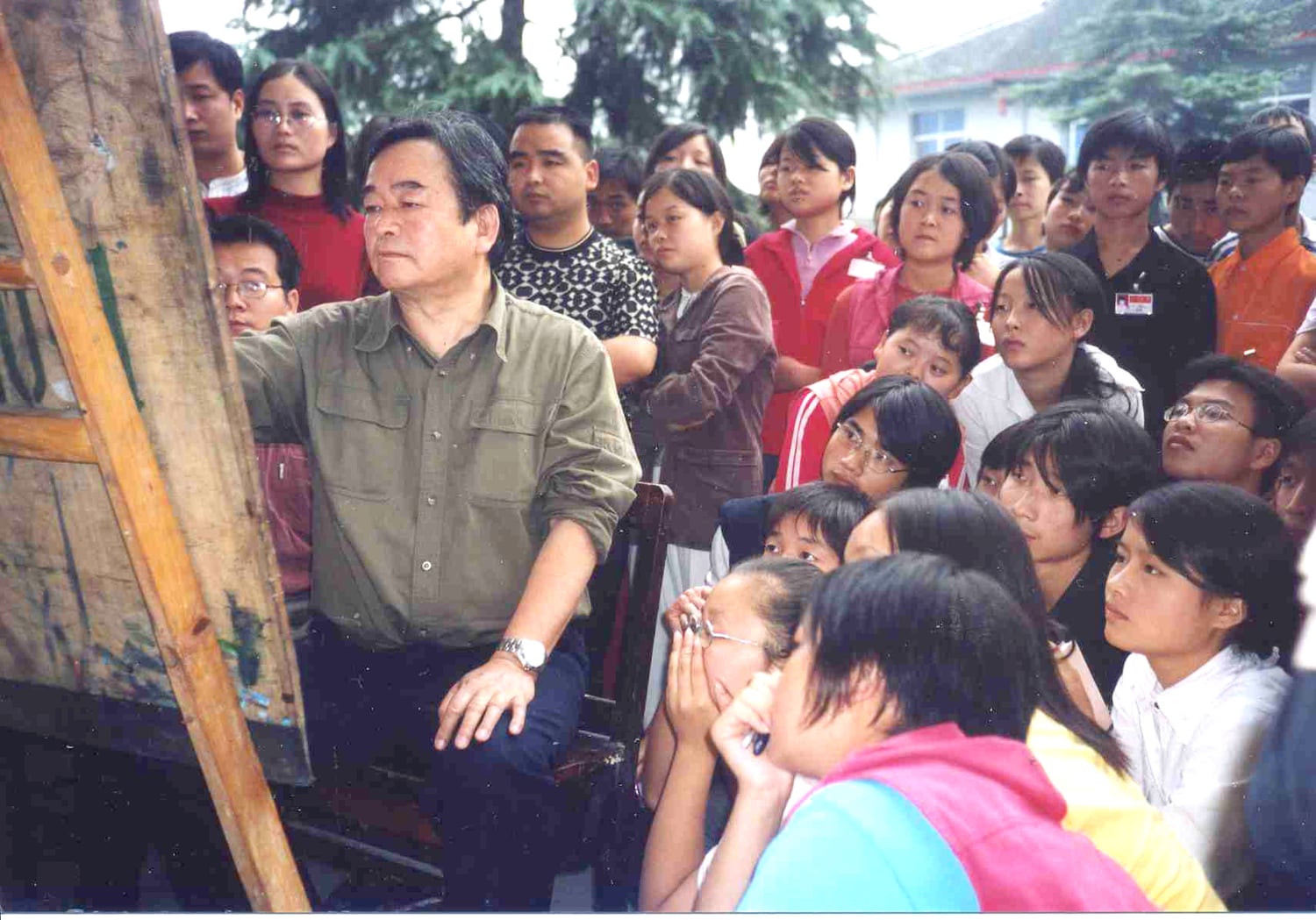
Yim Mau-Kun returned to Hunan a few times over the course of his life to sketch, teach, and exhibit. In 1998, he was invited to Taoyuan to give a drawing demonstration. In 2002, he returned again for a solo exhibition in Changde and also gave an oil painting demonstration.
The visit to Qingjiaping to see his cousins took place during the 1998 trip to Taoyuan.
After the drawing demonstration, Yim had already eaten. But he made one request: could the school arrange a vehicle to take him to Qingjiaping?
The school provided a jeep. A teacher accompanied him along with the driver. By the time they set out, it was already evening.
Three Torches in the Dark
The jeep slowly made its way toward Qingjiaping. There were no streetlights. Everything around them was dark.
Near the entrance to the village, Yim saw three figures waiting. Each held a torch that moved back and forth in the darkness.
They were his three cousins.
They knew he would be arriving that night, so they had walked down from their home to the point where a vehicle could still reach. They stood there with torches and waited.
Years later, Yim did not embellish the memory. He simply said:
The three brothers each held up a torch, waving it there, waiting for me.
But for a painter, the scene was almost already a complete composition: night, a mountain road, three farmers no longer young, three torches, and a cousin who had left home many decades earlier returning to see them.
The Jeep Could Go No Farther
The jeep had to stop below the house. Qingjiaping lay higher on the slope, and the rest of the way had to be covered on foot.
Yim got out and walked uphill with the three brothers until they reached the house they had built themselves.
His aunt was still alive. He remembered her as a small woman. The family had prepared a full table of food.
Not a single dish had been touched. Everyone had been waiting for him.
“Didn’t I Say I Had Already Eaten?”
Yim was surprised when he saw the untouched meal.
Didn't we agree? I was going to come after I had eaten.
The family answered that once he came home, he still had to eat. It was livelier when everyone ate together, and they had all wanted to see him.
So he sat down again and ate a little.
They had even prepared beer. It was not available nearby, so someone had to travel farther to buy it. Yim remembered that they probably went by bicycle.
These were small things: an untouched table of food, a few bottles of beer bought specially for him, three torches waiting at the roadside. But after many years apart, this was how family affection was expressed.
Sitting Down to Talk Through the Decades
The meal itself lasted only about half an hour, but at last the family sat together and talked.
Yim told his cousins how his own life had unfolded over the intervening years. They, too, had lived through one political campaign after another on the mainland. Somehow, everyone had endured.
He spoke about leaving the mainland, going first to Hong Kong, the death of his father Ran Peng, and his later move from Hong Kong to Taiwan. Around that table, pieces of decades that they had known little about were gradually filled in.
But when the conversation turned to his cousins' lives, there was one thing Yim could not put aside.
“All These Years, We Never Helped”
His cousins had remained in the countryside. They had received little formal education and had spent their lives working with their hands: farming, making bricks, building houses, and keeping their families going.
Yim had been away for many years. By the time he returned, they had lived completely different lives.
He told them:
All these years, you lived such hard lives in the countryside, and we were never able to help.
He spoke with a deep sense of regret. Not because he had broken some promise—he and his cousins had all been children shaped by circumstances beyond their control—but because, looking back late in life, he could see that he had found a way out while they had remained there.
What If He Had Stayed?
Their starting points had not been so different. They were only a year or two apart in age. They had lived together as children, worked in the fields together, and played together.
What if his mother had not taken him back to Changde? What if he had not returned to school? What if, after failing to enter Changde No. 1 Middle School the first time, he had not studied another year and tried again? What if he had never joined the art group? What if Hu Yichuan had never said, “He's still just a child”?
If any one of those moments had gone differently, might he too have remained at Shigutan? Might he have learned farming and carpentry, made mud bricks, and built his own house at Qingjiaping?
No one can know. That uncertainty was part of what made the reunion so complicated. These were not anonymous “farmers” to him. They were the children he had grown up with. Life had simply carried them in different directions.
One Thousand Dollars
Before going to Qingjiaping, Yim had exchanged some money into U.S. dollars.
Before leaving, he gave each cousin one thousand dollars and his aunt two thousand.
He did not describe the money as charity, nor did he pretend that it could compensate for decades of hardship. Of course it could not.
It was more like a belated gesture: I was away all these years. I was not able to help. Now that I have finally come back, let me at least leave something behind.
Back to Changde
The visit was short. The meal was over. They had talked. He had left the money. Then it was time to say goodbye again.
Yim returned to the same jeep and rode back from Qingjiaping to Changde. By the time he arrived, it was late.
Years later, he said:
That was the time I saw the most of them.
He did not mean that it was the visit with the greatest number of meetings. He meant that all three brothers were there, his aunt was there, and they had truly sat together and talked more than they ever had before.
Later, He Painted That Place Again
Yim later passed through the Sanyanggang and Shigutan area again. On one occasion, he painted a landscape nearby.
In the foreground were a few rice fields. Behind them rose a small hill with rural tiled roofs and wooden walls. Pines and fir trees surrounded the houses, and crows and magpies had built nests in the branches.
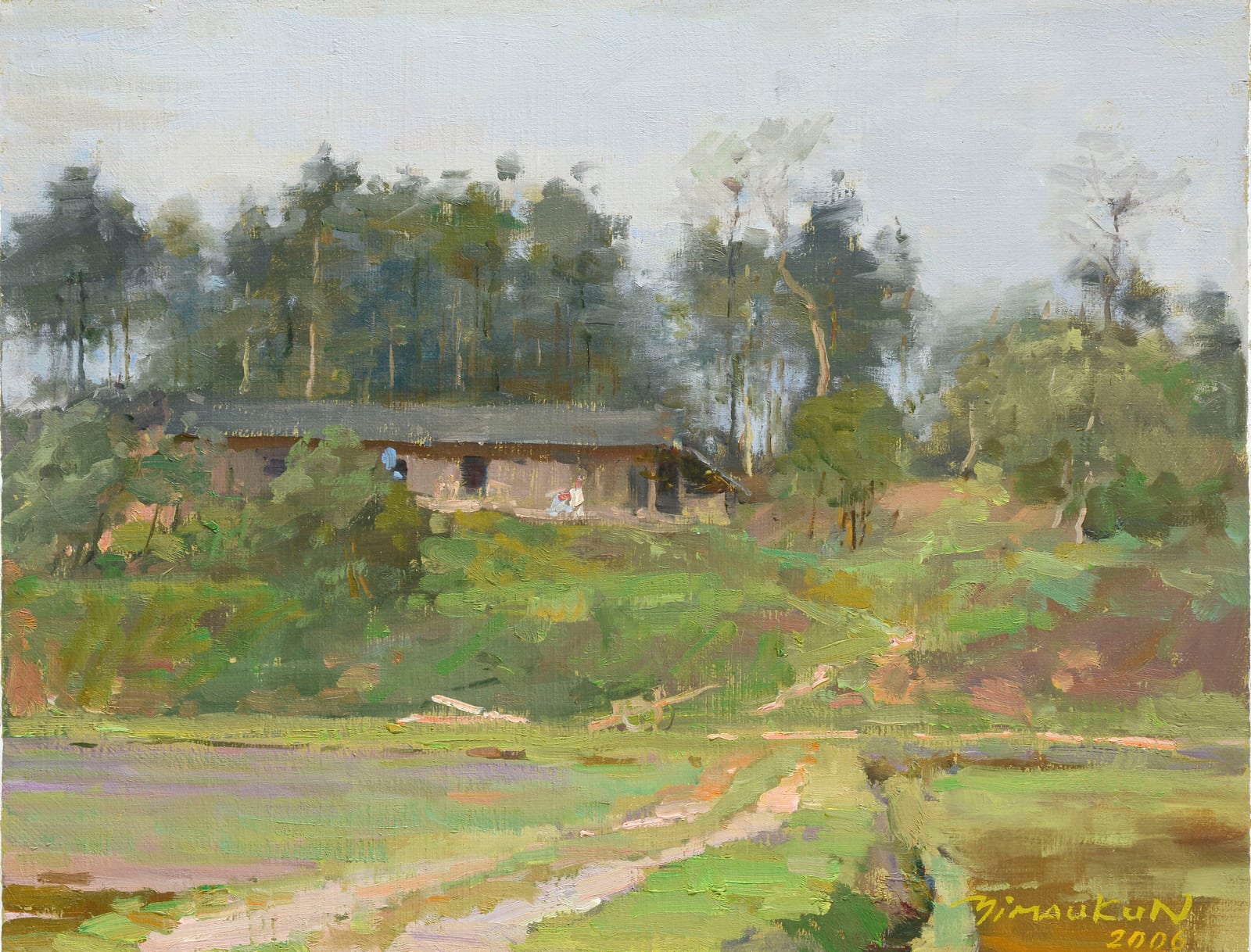
There were no people in the painting. Yet Yim said that the scene reminded him of the house where he had lived at Shigutan as a child.
For him, the painting was almost a memory of that period at Sanyanggang.
Perhaps when a painter returns home, painting becomes another way to hold onto things that are difficult to explain: a house, a hillside, trees, birds' nests. The foreground may be empty. No one is visible. Yet the people are all still there in memory.
Three Torches
If one image had to stand for everything that remained from this homecoming, it would probably be the moment just before Yim reached Qingjiaping.
Not the dinner table. Not the house. Not even the regret he expressed decades later.
It was the dark country road, before the jeep arrived, with three people waiting.
The three brothers who had once transplanted rice, harvested grain, and caught fish with him were now lifelong farmers. One was a year older than he was. One was a year younger. The youngest brother was there too.
Decades earlier, they had all been children running around Shigutan. Now one cousin had returned from Taiwan, while the other three had walked down the hillside from the houses they had built themselves.
No one needed to say anything profound.
Each man simply held a torch.
They did not want him to lose his way.
So they stood in the dark and waited for him to come home.